Solo Bitcoin Mining
Bitcoin Cash vs Bitcoin Solo Mining Odds, By the Numbers
Bitcoin Cash's network hashrate is a fraction of Bitcoin's. Here is what that gap actually means for solo mining odds, worked out with real 2026 figures.
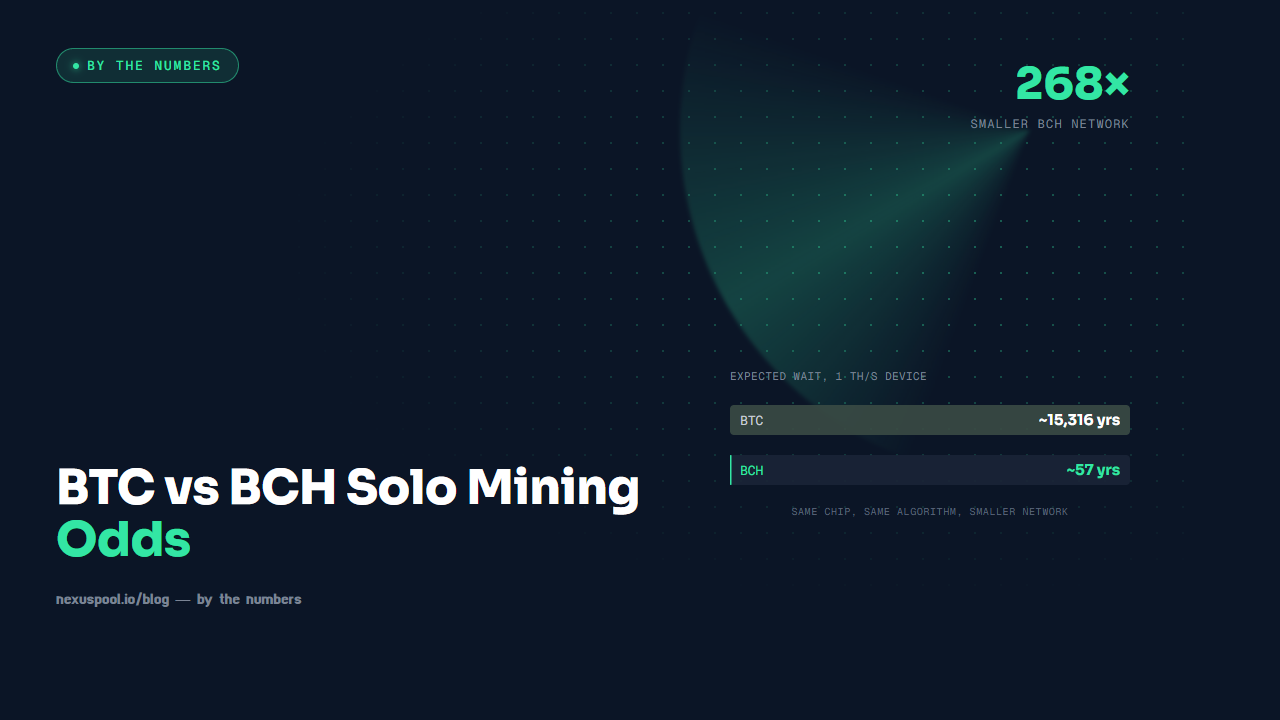
805,000,000. That is roughly Bitcoin's network hashrate in terahashes per second as of late August 2026, per CoinWarz's Bitcoin hashrate tracker, which puts the figure at approximately 805 EH/s. Bitcoin Cash, which shares Bitcoin's exact SHA-256 mining algorithm and can be mined with the same ASIC hardware, runs at roughly 3,000,000 terahashes per second over the same period, based on public BCH network trackers. That single ratio, a network more than two hundred times smaller, is the entire reason Bitcoin Cash solo mining odds come out so differently from Bitcoin's in the math below.
The starting numbers
| Figure | Bitcoin (BTC) | Bitcoin Cash (BCH) |
|---|---|---|
| Network hashrate (approx, late Aug 2026) | 805,000,000 TH/s | 3,000,000 TH/s |
| Mining algorithm | SHA-256 | SHA-256 (identical) |
| Target block interval | 10 minutes | 10 minutes (ASERT retarget) |
| Approx. blocks per year | 52,560 | 52,560 |
Both networks use the same proof-of-work algorithm, the same class of ASIC chip, and target the same 10-minute block interval, Bitcoin Cash through its ASERT difficulty adjustment algorithm rather than Bitcoin's every-2,016-block retarget, but landing on roughly the same annual block count either way. The only input that actually differs is how much total hashrate is competing for those blocks. A miner does not need separate hardware to test both: the same open-hardware SHA-256 device that points at Bitcoin today can be repointed at Bitcoin Cash with nothing more than a configuration change, since the chip itself does not know or care which chain's blocks it is hashing against.
Working out solo mining odds for a single device
Take a single open-hardware solo rig running 1 terahash per second, a modest but realistic figure for one entry-level ASIC board. The per-block probability of finding a block is that device's hashrate divided by the network's total hashrate.
On Bitcoin: 1 divided by 805,000,000 is approximately 1.24 x 10^-9, or about a 1-in-805-million chance per block. Multiplied across roughly 52,560 blocks per year, the expected number of blocks found per year is about 6.53 x 10^-5, meaning the expected wait to find one block is 805,000,000 divided by 52,560, or roughly 15,316 years.
On Bitcoin Cash: 1 divided by 3,000,000 is approximately 3.33 x 10^-7, or about a 1-in-3-million chance per block. Multiplied across the same roughly 52,560 blocks per year, the expected wait works out to 3,000,000 divided by 52,560, or roughly 57 years.
| Per-block odds (1 TH/s device) | Expected wait | |
|---|---|---|
| Bitcoin | about 1 in 805,000,000 | roughly 15,316 years |
| Bitcoin Cash | about 1 in 3,000,000 | roughly 57 years |
Scale the same device up to 3 TH/s, a small home cluster of a few units, and both numbers divide by three: about 5,105 years expected wait on Bitcoin, about 19 years on Bitcoin Cash. The ratio between the two chains stays constant at any hashrate, since the same device competes against a network that is roughly 268 times smaller on one chain than the other.
Why the gap is this large, and what it does not mean
The gap exists purely because far less global hashrate currently points at Bitcoin Cash than at Bitcoin. It says nothing about which coin is a better store of value, a better investment, or more likely to be worth more later; none of this is investment advice, and nothing about a smaller network makes a coin's future price or adoption more certain. It also does not mean Bitcoin Cash mining is free of the same solo-mining reality that applies everywhere: even a 57-year expected wait is an average over a highly random, geometrically distributed process. Some solo BCH miners will find a block far sooner than that average, and some will run for years and find nothing, exactly as some Bitcoin solo miners have found blocks with a single hobbyist device against far steeper odds. Expected value is not a promise, on either chain.
What the gap does mean concretely: identical hardware, identical algorithm, identical operating cost, produces a solo-mining probability more than two orders of magnitude better on the smaller network, for exactly as long as that network stays smaller. If that hashrate balance shifts, so does every number above, and it shifts constantly.
What to actually do with these numbers
If you already run SHA-256 hardware for Bitcoin and have never pointed any of it at Bitcoin Cash, these figures are the honest case for at least trying it alongside your existing setup, not instead of it, since nothing here changes what your Bitcoin hashrate is doing. NexusPool supports solo mining on Bitcoin Cash alongside Bitcoin, Litecoin, and Dogecoin through merged mining, and because payouts on any of those chains go directly to your own address rather than a pool-held balance, switching or splitting hashrate between chains does not introduce a new custody step to trust. Before pointing hardware at any new chain or new payout address, running NexusPool's Payout Preflight tool against the configuration first catches an address typo on a dry run instead of after a lucky find. None of this changes the underlying odds themselves, only which network you are computing them against, and the odds above are illustrative estimates from a single point in time, not a guarantee of any specific outcome.
Trust nothing. Verify the network hashrate before you trust anyone else's odds claim.