Glass Ledger
NexusPool v0.9.26: Proof, Not Promises
NexusPool's v0.9.26 release makes the pool more honest, fairer, and more transparent. Here's why solo miners choose proof over promises.
NexusPool doesn't ask you to trust it. Version 0.9.26 proves it again.
Most Bitcoin mining pools want one thing from you before anything else: your trust. Trust the dashboard. Trust the audit. Trust that the company behind the pool is still solvent, still honest, still doing what its terms of service say it's doing. NexusPool was built on a different idea. Don't ask a miner to trust anything that a Bitcoin node, a signature, or your own eyes can check instead.
The Promise, in Plain Terms
Strip away every acronym and NexusPool comes down to a short list of things that are true today, right now, and checkable by anyone.
The block reward pays your address directly. The coinbase transaction, the very first payment in a block, goes straight to the wallet you mine with. Nothing sits in NexusPool's custody waiting to be forwarded, nothing to freeze, nothing to lose if the pool ever had a bad day.
The pool fee is 0%. Find a block solo mining through NexusPool and the full reward is yours.
Glass Ledger gives you a receipt, not a promise. Every account gets a signed, verifiable record of the work the pool credited to you, the same cryptography Bitcoin itself runs on, not a phrase about "blockchain-verified" anything.
Stratum V1 and V2 share the same port. Whatever you're already running, an older Bitaxe, a brand-new NerdQAxe, doesn't need a translator or a firmware update to connect.
Payout Preflight shows you the future before it happens. Before you've ever found a block, you can see exactly where the reward would land if you did. Most miners never get to check that until it's too late to fix a mistake.
None of that is new to version 0.9.26. It's the reason NexusPool exists at all. What 0.9.26 does is make every one of those promises a little harder to break.
What Changed in NexusPool v0.9.26
Here's what solo miners actually get out of this release, translated out of the changelog and into what it means for you.
When something goes wrong, you now hear what actually went wrong. A vague "pool is busy" message used to cover more ground than it should have. It doesn't anymore. If a request fails, the pool now says so specifically, instead of hiding a real problem behind a generic answer.
Your work can no longer be handed to someone else by mistake. A job the pool has already assigned to your rig stays yours until it's done. That sounds obvious. Getting it provably true, every time, under real network load, is the actual work, and it's done.
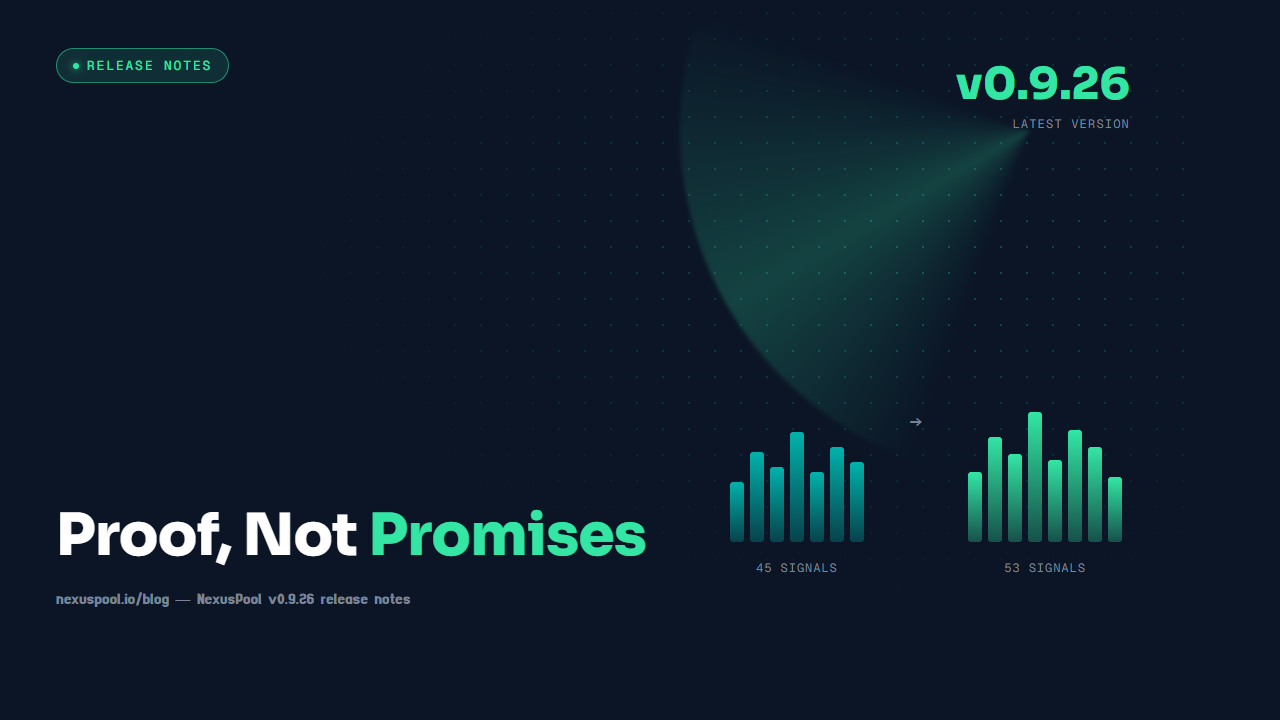
The pool got more transparent, not less. NexusPool now publishes 53 live health signals about its own operation, up from 45 a version ago. Every one of those eight new numbers was invisible before. Now they're public, in real time, alongside everything else.
It was tested against the real Bitcoin network, not a simulation of one. The release went through integration testing directly against real Bitcoin consensus rules, not just internal checks, the kind of edge cases that only show up when an actual node judges the result. It passed clean.
What's running matches what's published, guaranteed. A deployment bug that could let a live pool quietly drift out of sync with its own public changelog got found and closed for good, on every server, before it ever caused a mismatch a miner would notice.
Every one of those five things is a small, honest fix. None of them changes your odds of finding a block. That's the point. NexusPool doesn't improve by chasing a bigger promise. It improves by making the existing promise harder to break.
Why NexusPool Is a Different Kind of Mining Pool
Plenty of pools will tell you they're transparent. Plenty will tell you they're secure, or fast, or trustworthy. NexusPool's answer to all three is the same: don't take our word for it. Check the receipt. Watch the live numbers. Preview your own payout before you've earned it. Read a changelog that names its own bugs instead of burying them.
Before any fix ships, it gets measured against the best solo mining software already out there, and it only ships if it holds up to that comparison. Not because a marketing team said so, because that's the bar the team building this pool set for itself, on every release, including this one.
That's a slower way to build a pool than just claiming to be the best. It's also the only way to actually earn that claim instead of printing it.
The Part That Doesn't Change, and Never Will
Solo mining is still a lottery. The odds of finding a block are fixed by the Bitcoin network's difficulty, the same for every miner at every pool, this one included. Nothing in version 0.9.26, or any version after it, changes that math by a single percentage point. An average wait time is not a schedule. A smaller difficulty window shortens the expected wait, it doesn't make the win worth more. Anyone telling you otherwise is selling something NexusPool won't.
What NexusPool sells instead is simpler: if you're going to take the lottery ticket anyway, take it somewhere that pays you directly, shows its work, and gets caught fixing its own bugs in public instead of hiding them.
Try NexusPool Yourself
Point a Bitaxe, a NerdQAxe, or any Stratum-speaking rig at NexusPool today and see the difference firsthand. No signup wall, no earnings calculator, no dashboard asking you to just believe it. Check the Payout Preflight before you mine a single share. Read the changelog. Watch the live health numbers move in real time. Everything in this post is something you can go verify right now, not something you have to take from a blog post, including this one.
Trust nothing. Verify the version you're actually connected to.