Glass Ledger
The BLAKE2b Fork: A Bitcoin Holder's Checklist
Luke Dashjr launched a Bitcoin hard fork on September 1 to swap out SHA-256. Here is a plain checklist for what, if anything, you actually need to do about it.
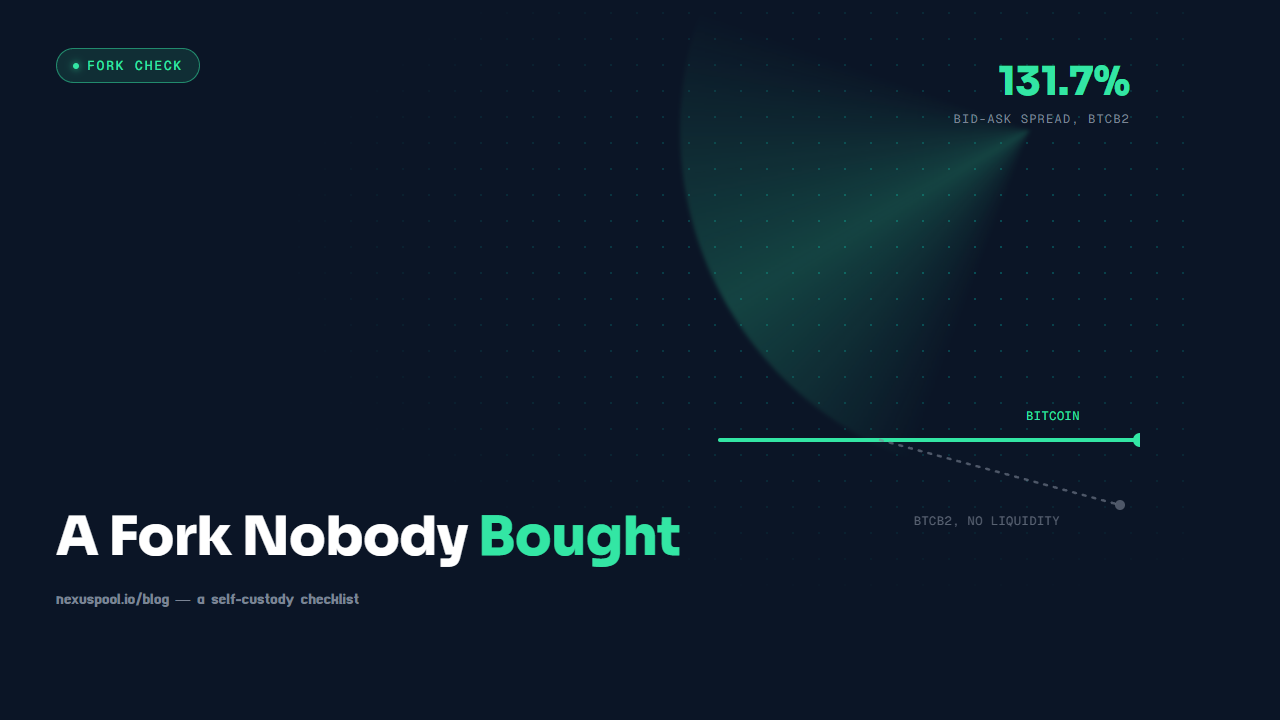
On September 1, 2026, Bitcoin developer Luke Dashjr launched a hard fork that swaps the SHA-256 hashing algorithm for BLAKE2b, a change he argues removes ASICBoost, a mining optimization that gives an efficiency edge (commonly cited around 20 percent) to whoever holds the patent rights or the largest fleets. The BLAKE2b Bitcoin fork also opens mining back up to ordinary CPUs, since a general-purpose processor can compute BLAKE2b hashes without the specialized silicon that SHA-256 mining now requires. Dashjr resigned as chairman and chief technology officer of the mining pool OCEAN the same week and now refers to the original Bitcoin chain, the one everyone still calls Bitcoin, as "Spamcoin."
If that sounds alarming, the actual market response was not. No major exchange listed the forked coin, sometimes referred to as BTCB2. A small beta trading venue showed bids around $82 and asks around $190 for it, a spread of roughly 131.7 percent, which is what negligible liquidity looks like on a chart. Bitcoin itself kept trading normally through the split, and BeInCrypto's coverage of the launch confirms none of the major exchanges moved to list the forked asset. Bitcoin developer Adam Back summed up the reaction with a one-line jab: "Live by the fork, die by the fork."
None of that means the event is worth ignoring outright. A hard fork changes consensus rules, and knowing whether it touches you is worth five minutes. Below is a plain checklist, not a set of predictions about where BTCB2 goes next.
Bitcoin has seen contentious forks succeed before. The 2017 split that created Bitcoin Cash carried real, sustained support from miners, exchanges, and businesses who disagreed with Bitcoin's block-size roadmap, and it kept enough hashrate and enough economic activity to survive as its own chain for years afterward. The BLAKE2b fork has not shown any of those signs so far: no major exchange has listed it, its own beta trading venue shows a spread wide enough to signal almost no real buyers or sellers, and the hashrate needed to secure it, which can only come from CPUs since ASICs cannot compute BLAKE2b, has not materialized at any meaningful scale. That distinction, between a fork with organized economic backing and one built mostly around a single developer's objection to ASICBoost, is worth keeping in mind before treating every hard fork announcement as equally significant.
The BLAKE2b Fork Checklist
Work through these in order. Most Bitcoin holders and miners will find every box unchecked, and that is the expected outcome for this particular fork.
- Does your exchange or custodian list BTCB2 or any BLAKE2b-forked asset? As of this writing, none of the major venues do. If yours does not either, there is nothing to claim, split, or move.
- Does your wallet software require a manual update to keep working on the original Bitcoin chain? No. Full nodes and wallets running unmodified Bitcoin Core, or any client that never adopted BLAKE2b's rule changes, continue validating the chain exactly as before. The fork is the one that diverged, not the network you were already on.
- Are you mining Bitcoin with ASIC hardware today? If so, BLAKE2b changes nothing about your setup. ASICs are built for SHA-256 and cannot mine the forked chain at all; CPU-only miners are the ones who can participate in it, and CPU hashrate is nowhere near ASIC hashrate in aggregate, which is a large part of why the forked chain has struggled to attract any meaningful hashrate of its own.
- Did you receive an email, DM, or "claim your forked coins" link referencing this event? Forks are reliable phishing bait. Nobody needs your seed phrase, private keys, or a signed transaction to "register" for a fork. Delete it.
- Are you running a Stratum V2 client, on NexusPool or elsewhere, and worried it needs reconfiguring? It does not. Stratum V2 and Stratum V1 both speak to the SHA-256 chain miners have always mined; nothing about NexusPool's protocol support, encrypted and authority-key-pinned as it is, changes because a minority chain forked away from it.
If You Checked None of the Boxes
Do nothing. That is the correct outcome for the overwhelming majority of Bitcoin holders and solo miners reading this, and it is also the outcome the market has already priced in through the fork's near-total absence of exchange support and liquidity.
If You Checked One or More
Move slowly. If an exchange does eventually list a BLAKE2b-forked asset and you hold Bitcoin there, read the exchange's own claims process directly on their site, never through a link in an unsolicited message. If you are unsure whether a transaction actually landed on the chain and address you expected, a tool like NexusPool's Payout Preflight, which reconstructs and checks a coinbase transaction byte for byte before a block is even found, is the kind of verification habit worth building regardless of any particular fork. Verifying which chain a transaction settled on, rather than trusting a screenshot or a third party's claim, is the same instinct that self-custody asks of you every day, fork or no fork.
None of this changes the math of solo mining, either. A CPU miner chasing BLAKE2b blocks or an ASIC miner chasing SHA-256 blocks both face odds set entirely by that chain's current difficulty divided by their own hashrate, identical for every participant on that chain, and no fork, pool, or protocol changes that arithmetic. This isn't a recommendation to mine either chain, and nothing here is investment advice; it's a description of what actually happened and what, if anything, it asks of you.
Bitcoin has forked before and will fork again. Most forks, like this one, fail to attract meaningful hashrate, exchange support, or lasting attention, and the ones that matter tend to announce themselves through years of public debate, not a single September morning. A non-custodial setup like NexusPool itself, where the coinbase transaction pays your own address directly and nothing sits in a pool-held balance, does not depend on any single fork's outcome to keep functioning exactly as it did the day before.
Trust nothing. Verify which chain your own transactions actually settled on.