home mining
Home Mining Essentials That Actually Matter
Home mining essentials for Bitcoin miners: size hardware, measure power and heat, secure your network, and verify where every share goes before startup.
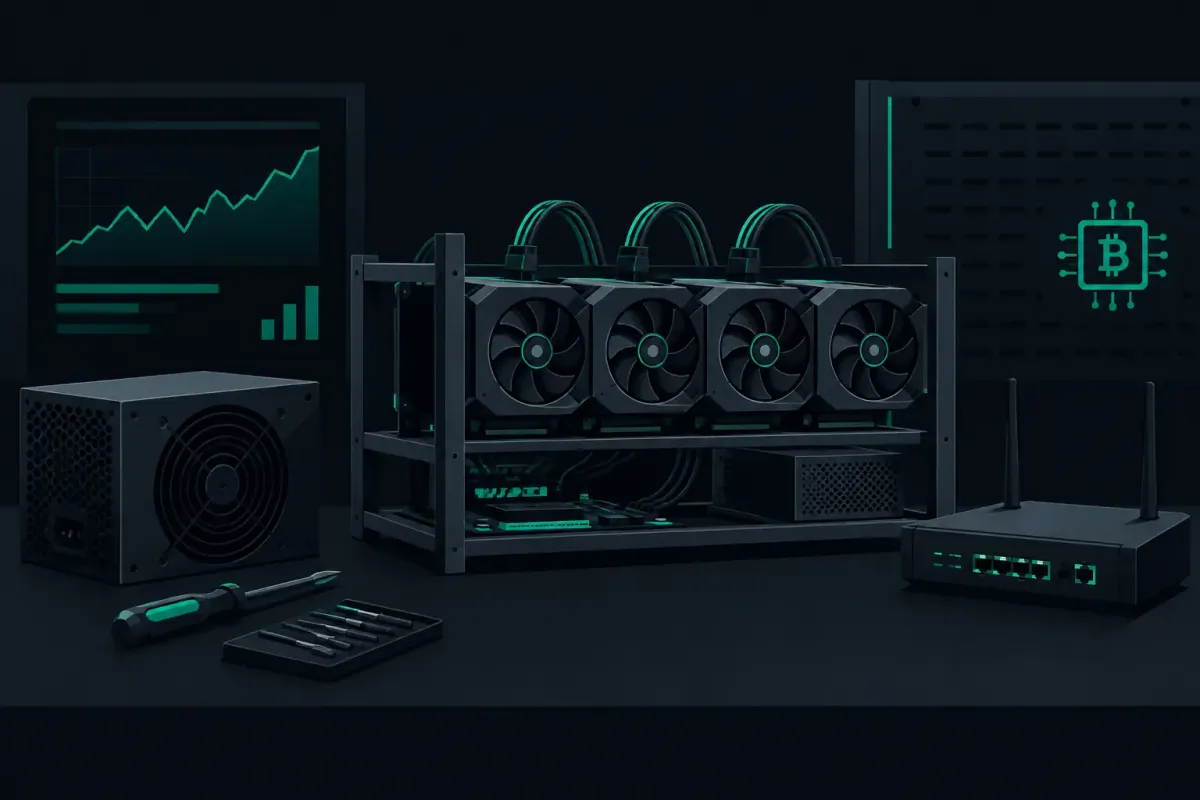
A home miner does not need a warehouse. It needs an honest plan for watts, heat, noise, network reliability, and variance. Those are the home mining essentials that decide whether your rig becomes a useful part of your Bitcoin setup or an expensive space heater with a flashing web dashboard.
For solo and lottery mining, start with the fact that no pool changes your odds. Hashrate buys attempts, not a schedule. A small miner can find a block. It can also run for years without finding one. The right setup is one you can afford to operate, inspect, and leave running without pretending that probability is income.
Home Mining Essentials Start With the Job
Choose hardware based on the job you want it to do. A Bitaxe Gamma, NerdQAxe++, or similar ESP32-class miner is usually easier to place in a home than a full-size ASIC. It draws less power, produces less heat, and gives you a practical way to learn Stratum, tuning, cooling, and monitoring. It also has far less hashrate than an industrial machine. That is not a flaw. It is the trade-off.
A standard ASIC makes sense when you have the electrical capacity, ventilation, and tolerance for sustained fan noise. Do not compare machines only by advertised hashrate. Compare the complete operating condition: watts at the wall, expected room temperature, available circuit capacity, and whether the machine can reject heat without warming the rest of the house.
Efficiency matters because electricity is the recurring cost you cannot negotiate away. If a miner draws 500 watts continuously, it uses 12 kilowatt-hours per day. At $0.15 per kilowatt-hour, that is $1.80 per day before any hardware cost. A 3,000-watt ASIC uses 72 kilowatt-hours per day, or $10.80 per day at the same rate.
Those numbers are not a prediction of profit. They are the cost side of a calculation. Your actual result depends on network difficulty, your hashrate, uptime, transaction fees when a block is found, and whether you are mining solo or using another payout method. Write down the power cost before you buy hardware. Optimism does not lower a utility bill.
Power Is the First Physical Constraint
Treat continuous mining load differently from plugging in a lamp. A miner may run at full draw for months. Circuit ratings, outlet condition, wire gauge, and breaker capacity matter. In the United States, continuous loads are commonly planned at no more than 80% of a circuit's rating. A 15-amp, 120-volt circuit should not be treated as 1,800 watts of mining headroom.
Use a watt meter or a properly rated power distribution unit to measure actual draw. Manufacturer figures are useful, but firmware settings, fan speed, and input voltage affect the number at the wall. Avoid cheap extension cords, overloaded power strips, and adapters of unknown quality. Heat at a plug or cable is a warning, not a personality trait of mining hardware.
A larger ASIC may require 240-volt service and a dedicated circuit. If you are not certain what your panel, outlet, or wiring supports, use a qualified electrician. Bitcoin mining is not a reason to improvise around mains voltage.
Plan for outages and restarts
A brief outage is normal. A miner that fails to reconnect is an operational problem. Configure automatic startup after power loss where your hardware supports it. Check that the rig reconnects to its pool, retains its payout address, and reports accepted shares after a reboot. A small uninterruptible power supply can protect networking equipment, but it is usually not sized to keep an ASIC mining through an outage.
Heat and Noise Need a Real Location
Every watt a miner consumes becomes heat in or near your home. A 1,000-watt miner is roughly equivalent to a 3,412 BTU-per-hour heater. This can be useful in a cold workshop during winter. It is less useful in a bedroom in July.
Give the machine a defined air path. Cool air enters. Hot air leaves. Recirculating exhaust is one of the fastest ways to raise chip temperatures, increase fan noise, and trigger throttling. A garage, utility room, basement, or ventilated enclosure can work, but each has limits. Garages can be dusty. Basements can be humid. Enclosures can trap heat if their intake and exhaust are undersized.
Noise is not just a comfort issue. It affects where you can run hardware consistently. Small open-source miners may be acceptable on a desk after tuning. Full-size ASICs often are not. Measure before making promises to the people who share your walls. Fan specifications do not tell the whole story once a machine is pushing hot air through a room.
Clean filters and heat sinks on a schedule that matches your environment. Dust is an insulator. Do not blast a running board with compressed air and call it maintenance. Power down, follow the hardware maker's instructions, and inspect connectors while you are there.
The Network Is Part of the Miner
Mining traffic is small, but it is time-sensitive. A stable wired Ethernet connection is preferable for fixed hardware. Wi-Fi can work for small rigs, especially where wiring is impractical, but it adds another failure point. Signal strength, roaming behavior, router updates, and crowded radio channels all matter more when the device must stay connected continuously.
Put miners on a network segment you can manage. Change default passwords. Keep firmware current from sources you can authenticate. Reserve DHCP addresses if that makes monitoring easier. Do not expose a miner's administration page directly to the public internet just to check temperatures from outside the house.
Latency does not change the difficulty of a valid hash. It can affect how quickly your miner receives new work and how much effort lands on stale templates after the network moves on. Test the route from your location, watch rejected and stale share rates, and investigate sudden changes. A dashboard that says “connected” is not proof that the connection is healthy.
Configure Ownership Before You Hash
Your payout address is not a cosmetic field. It determines where a block reward goes if your work finds a valid block. Verify the address character by character before starting. Use an address you control, with backups for the wallet that controls it. Do not use an exchange deposit address for a setup designed around direct on-chain payment. Exchanges can change deposit policies, and the keys are not yours.
Worker names are operational labels. Make them useful. A name that identifies the device and location helps when one rig starts submitting fewer shares or disappears after a breaker trip. Avoid putting sensitive information into a worker name. Pool infrastructure does not need your street address to route work.
For Bitcoin, NexusPool accepts connections at nexuspool.io:3350, which points to its Los Angeles server, or pool.nexuspool.io:3350, which routes toward the closer healthy North American point of presence. Its single port supports Stratum V1 and native encrypted Stratum V2. That matters for home miners because most existing devices still speak V1, while Bitaxe AxeOS and BraiinsOS+ can speak V2 natively. A translator is not required just to use the same endpoint.
Protocol support is only one question. Ask what you can verify about the work path. Can you see whether shares were accepted? Can you check current difficulty per rig? Can you identify the block template you were working on? If a block is found, can you verify the payout transaction and destination address on-chain rather than relying on a balance inside a pool account?
Verify the Pool, Not Just the Screen
A mining pool sits between your hardware and Bitcoin's block-production process. That does not make every pool untrustworthy. It does mean the boundaries should be explicit. Who constructs the payout? Who controls the reward before payment? Which records are independently checkable? What happens if the dashboard and the chain disagree?
For a solo miner, the cleanest model is direct payment to the Bitcoin address configured by the miner. The block subsidy and transaction fees belong to the miner who solves the block under that arrangement. There is no account balance that must later be withdrawn and no pool wallet holding a claim on your reward.
NexusPool's Payout Preflight is designed for this question. Before you commit hashrate, it verifies that the configured payout address can be used in the payout construction path. Its Glass Ledger provides cryptographically signed records intended to make work accounting inspectable. These mechanisms do not improve luck. They address a separate problem: whether your work and a potential reward can be checked without blind trust.
Keep your own records too. Save configuration changes, take periodic screenshots of hashrate and accepted shares, and note firmware versions and power settings. When something changes, a record turns guessing into diagnosis.
A home miner is small infrastructure with real consequences. Build it like infrastructure. Measure the watts. Move the heat. Protect the keys. Check the work. Trust nothing. Verify your work.