Non-Custodial Mining
Blink Wallet Hack: Custodial Myth vs Reality
Blink Wallet's breach drained custodial accounts but left its non-custodial Spark accounts untouched. Here is what that split actually proves.
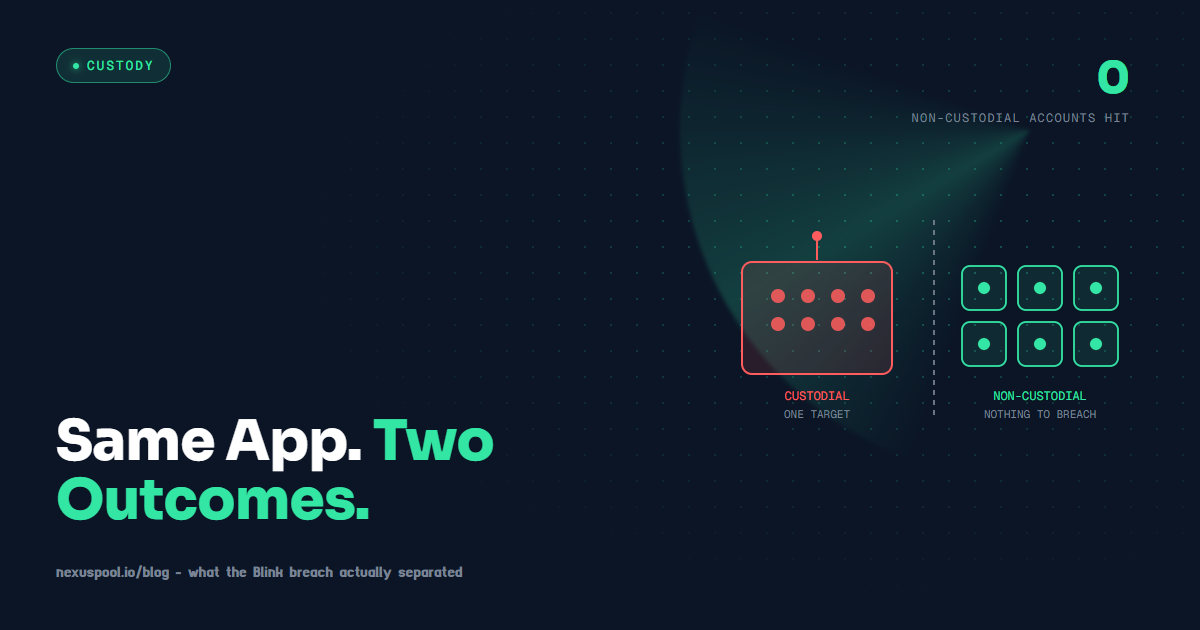
The Blink Wallet hack broke on September 19, when the Bitcoin Lightning payments app, used across dozens of countries, paused its services after discovering an attacker had accessed and drained funds from a limited number of accounts. The company later confirmed the number affected: a few dozen custodial accounts, meaning accounts where Blink itself held the keys on a user's behalf. It has not disclosed the total value taken, how the attacker got in, or whether any funds were recovered. It did restore services the same day, roughly eight hours after the pause, and said every affected account had been identified and would be made whole without users needing to take any action, with a full post-mortem still to come.
What makes this Blink Wallet hack worth a closer look is not the breach itself. Custodial breaches happen. What makes it worth examining is the line the incident drew, cleanly and by accident, between what got touched and what did not. That line is a genuine test of a claim self-custody advocates make constantly and rarely get to see demonstrated this precisely in a single incident.
Myth: a well-known wallet app means the Blink Wallet hack couldn't happen to you
The assumption behind trusting any wallet app, custodial or not, is that a reputable company with a security team and a patch process has your funds handled. Blink is not a fly-by-night operation. It has years of operating history, an established user base, and had already deployed a patch by the time it disclosed the breach publicly.
Reality: reputation and security competence do not eliminate custodial risk, they only reduce how often it materializes. A custodial account is, structurally, an IOU backed by an operator's promise and an operator's security posture, no matter how good either one is. Blink's custodial accounts were attacked and drained regardless of the company's track record, because a custodial balance is a target that exists specifically because the operator, not the user, controls the keys.
Myth: custodial and non-custodial funds in the same app share the same risk
Blink offers two modes inside the same app: a custodial mode where the company holds funds, and a non-custodial mode built on the Spark protocol, introduced in mid-2026, where users hold their own recovery phrase and Blink cannot access, freeze, or recover the funds even if it wanted to.
Reality: the breach makes the distinction concrete rather than theoretical. The attacker reached custodial accounts. The non-custodial Spark accounts, running on the same app, built by the same company, were not implicated at all. Same brand, same codebase for the interface, structurally different exposure, because the keys live in different places. One custody model gave an attacker a target to compromise. The other did not, because there was no centralized key store to reach.
| Custodial mode | Non-custodial (Spark) mode | |
|---|---|---|
| Who holds the keys | Blink | The user |
| Affected in this breach | Yes, "a few dozen" accounts | No |
| Recovery if company is compromised | Depends on company's response | Unaffected regardless of company status |
| What an attacker needs to steal funds | Compromise the operator | Compromise the individual user's device |
Myth: this incident says something bad about Lightning itself
Because the breach hit a Lightning wallet, it is tempting to read this as a Lightning Network security story. It is not one. Lightning is a payment protocol; custody is a separate, orthogonal decision about who controls the keys that move over that protocol.
Reality: this was an account-custody compromise, the same category of failure that has hit custodial exchanges and custodial wallets going back to Bitcoin's earliest years, running on infrastructure that happened to be Lightning. Blink itself has been actively migrating users toward non-custodial Spark accounts in several regions ahead of regulatory deadlines this year, which suggests the company had already identified custodial concentration as the harder problem to manage long term, independent of this specific breach.
What the Blink Wallet hack means if you solo mine
Solo mining through a non-custodial pool sidesteps this entire category of risk at the payout layer, for a specific structural reason rather than a marketing one. NexusPool's design pays a found block's coinbase transaction directly to whatever address a miner configures. There is no pool-held balance sitting between a block being found and a miner controlling it, which means there is no custodial account of the kind Blink's attacker went after, because that account never exists in the first place. The signed Glass Ledger receipts covering each job exist so a miner can check that accounting rather than take it on faith.
That does not make a miner's own wallet immune to compromise; a hardware wallet or cold-storage address is only as safe as the practices around it. NexusPool's Payout Preflight tool reconstructs and checks a coinbase transaction before a block is even found, so miners can verify where a payout will actually land ahead of time rather than trusting a promise after the fact. It is a verification tool, not a security guarantee, and it does not touch the separate question of protecting the wallet the payout goes to.
This is not investment advice, and 0% pool fees paid directly to a miner's own address are not a return, a yield, or a promise of profit. Solo mining odds are set entirely by a chain's difficulty relative to a miner's own hashrate, identical for every participant, and no custody model changes that math one bit. Bitcoin.com's reporting on the breach has the fuller account of what Blink has disclosed and what remains unknown about the incident.
The reality, in short
Custodial and non-custodial funds inside the same app faced two entirely different outcomes in the same breach, on the same day, because one model concentrates keys in an operator an attacker can target and the other does not.
Trust nothing. Verify which custody model is actually holding your funds, not which brand's logo is on the app.