Decentralization
Mining Decentralization Starts With Your Payout
Mining decentralization is not a slogan. It means fewer trust points between your rig, a valid block, and the address that receives its reward on-chain.
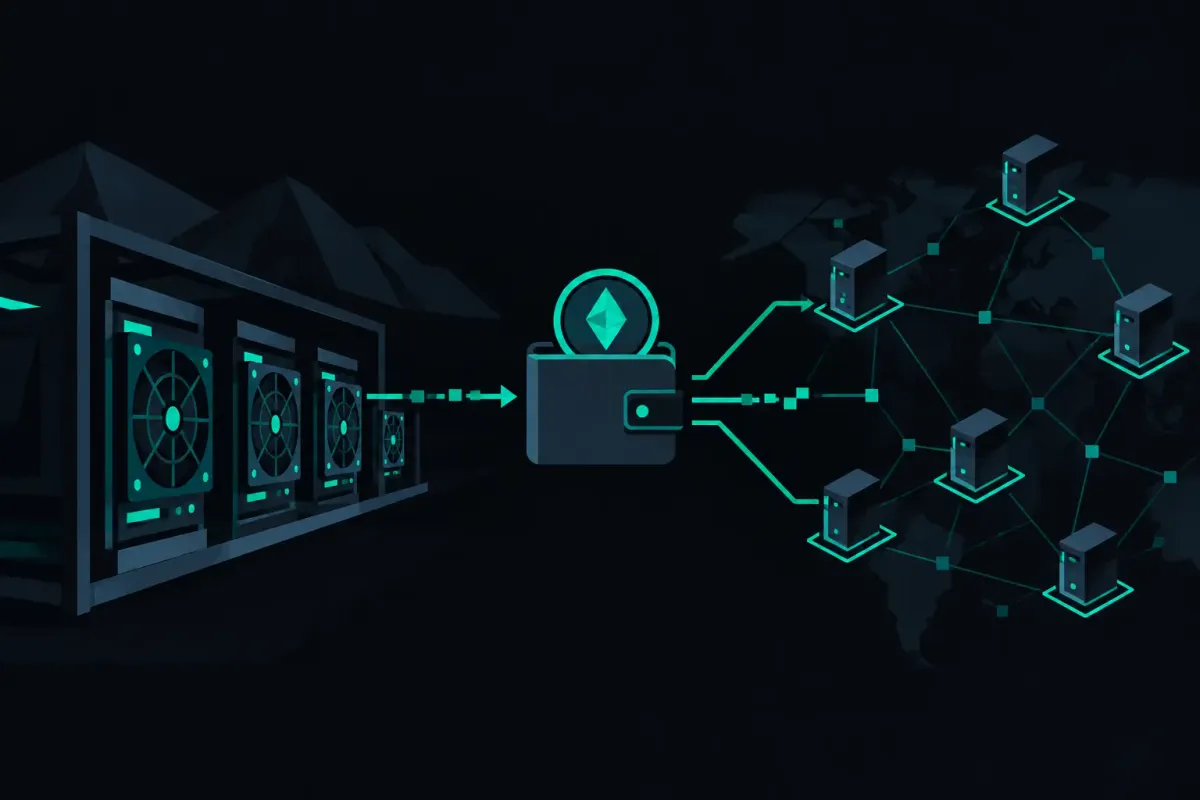
A miner can point a rig at a pool in minutes. The harder question comes after the connection succeeds: who controls the path between your work and your reward? Mining decentralization is the practice of reducing the parties and systems that must behave honestly for that path to work.
That question matters even for a small home miner. A Bitaxe does not need to command a meaningful share of global hash rate to have a claim worth defending. If it finds a valid block, the block subsidy and transaction fees are not a pool balance. They are a Bitcoin transaction that should pay the miner's chosen address.
Solo and lottery mining have high variance. A miner may run for a long time without finding a block. Network difficulty and the miner's hash rate set those odds. Pool design does not improve them. It determines what happens around the work: who provides jobs, who can see the shares, who builds and submits a found block, and who controls the destination of its reward.
Mining Decentralization Has More Than One Layer
People often use decentralization to mean hash rate spread across many owners. That is one layer. It matters because a small number of entities controlling a large share of hash rate can create risks for Bitcoin's consensus process.
It is not the whole picture. A mining setup can have many independent hardware owners while still concentrating practical authority elsewhere. The same operator might provide work templates, depend on one node, hold reward funds, or require miners to trust an internal accounting database. Each dependency is a separate point where a miner has to accept a claim without direct proof.
For an individual miner, four questions make the issue concrete.
First, where does the mining job come from? A job represents a candidate block and the work needed to search for a valid hash. The source of that job affects what transactions and block header a miner is working on.
Second, what node validates the chain state behind that job? A full node enforces Bitcoin's rules. If a pool is operating its own node, it can independently validate the chain and construct work from that node's view. If it is only relaying someone else's view, that upstream dependency becomes part of the mining path.
Third, what happens when a valid block is found? Speed and redundancy matter here. A winning block needs to reach Bitcoin nodes for propagation. A submission path that depends on one machine or one region has an obvious failure mode. More submission routes can reduce that operational dependency. They cannot guarantee a block will be accepted. Bitcoin nodes still apply their own consensus and policy checks.
Fourth, where does the coinbase transaction pay? This is the custody question. A pool can receive a reward first and later send a balance to a miner. Or the block can be constructed to pay the miner's address directly. Those are different trust models.
The Payout Transaction Is the Cleanest Test
A pool's interface may show a balance, a share count, or a projected reward. None of those is an on-chain payment.
Bitcoin gives miners a simpler test when they are mining for a direct payout. Before a block exists, the pool can show the address where the coinbase output would pay if a valid block is found. After the block is accepted, the transaction itself records the destination and amount on-chain.
This does not remove every dependency. The pool still supplies work and may submit the found block. A miner still trusts their own hardware, network connection, firmware, and payout address entry. If the miner enters the wrong address, direct payment faithfully sends coins to the wrong address.
It does remove a major category of risk. There is no reward balance for the operator to hold on the miner's behalf. There is no later withdrawal request. The miner can inspect the coinbase transaction and see whether the reward went to the address they supplied.
For a solo miner, this design also keeps the economics plain. A found block pays once. It does not create a stream of yield. It may never happen for a given miner. The relevant question is not what a dashboard forecasts. The relevant question is whether the payment path is visible before the result exists.
Verification Must Cover the Unexciting Parts
A system does not become verifiable because it uses a signature somewhere. The verifier needs to know what was signed, which public key verifies it, and what the signed statement means.
Share accounting is a good example. A pool receives shares that prove a rig performed work at an assigned difficulty. Those shares are not Bitcoin blocks. They are evidence used for pool-side monitoring, connection accounting, or lottery qualification. A miner should be able to distinguish a share record from a claim that coins are owed.
NexusPool signs an hourly custody receipt for each address from which it counts shares. The published receipt format identifies the exact bytes covered by the signature. A miner can check those bytes against the pool's published verification key rather than treating a dashboard number as proof. The receipt does not change block-finding odds. It creates evidence of what the pool counted at a particular time.
The same standard applies to rejected shares. A rejection without a reason leaves a miner guessing whether the cause was stale work, an invalid nonce, a duplicate submission, or a connection problem. A stated reason does not make a rig healthy by itself. It gives the miner a fact to investigate.
This is where decentralization becomes practical rather than philosophical. The goal is not to eliminate every service from the mining path. A home miner may reasonably use shared infrastructure for job distribution and block submission. The goal is to make each service's authority narrow, observable, and easier to replace when it fails.
Protocol Choice Changes Who Can Inspect the Connection
Many home rigs and standard ASICs speak Stratum V1. It remains common because existing hardware supports it. Native Stratum V2 adds capabilities such as encrypted transport through the Noise protocol and authority-key pinning, which lets a miner verify that the expected server controls the connection authority.
Neither protocol changes the probability that a hash meets the Bitcoin network target. That probability is mathematical. Protocol choice changes communication behavior and, in some cases, what a miner can authenticate or encrypt on the way to the pool.
Supporting both protocols on one port is useful when a miner operates mixed hardware. A legacy ASIC can keep using Stratum V1. A compatible miner can use encrypted Stratum V2. The connection decision does not need to force a hardware replacement.
There are limits worth keeping in view. Encryption protects the transport between a rig and the endpoint. It does not prove that a candidate block will pay the address you intended. Key pinning verifies an expected authority key. It does not validate every operational claim an operator makes. Each mechanism solves a specific problem. Treating it as a general trust stamp defeats the point.
Independent Nodes and Regions Reduce Operational Choke Points
A mining pool needs a current view of its chain. That means a full node that validates blocks and transactions under Bitcoin's consensus rules. Running an independent node is not a magic word. The useful question is whether the mining service has its own validated chain view or relies on a shared upstream dependency.
Regional design also has a practical role. A miner close to Los Angeles, Chicago, Frankfurt, or Singapore may see lower round-trip time to a healthy endpoint than a miner far from those locations. That can affect how quickly a rig receives new work and how promptly its shares reach the service.
Distance does not change block odds. A miner in Australia, South America, or Africa has the same chance per hash at the same network difficulty as a miner elsewhere. Latency can still matter around job changes. A rig working on an old job after a new block arrives may submit stale shares, which do not count as valid work for the new template.
A found block deserves extra redundancy. Writing the event to a local journal before submission preserves a record of what happened. Submitting to Bitcoin nodes across more than one region can keep one local failure from becoming the only path for the block. Automatic retries help with transient failures. None of this overrules the network. The block must still be valid, timely, and accepted by nodes.
Decentralization Is a Discipline of Smaller Promises
The useful version of mining decentralization does not ask miners to believe that a service is virtuous. It asks the service to make fewer claims that require belief.
A miner should be able to identify the payout address before a win. A miner should be able to separate a signed accounting receipt from an on-chain reward. A miner should know whether a connection is encrypted and what key it authenticates. A miner should understand that independent node operation and regional failover reduce certain operational dependencies, not the mathematical variance of solo mining.
That is a better standard than a badge or a slogan. Keep the work yours. Keep the payout path visible. Trust nothing. Verify your payout path.