Self-Custody
Brazil's $10K Self-Custody Rule: Myth vs Reality
Brazil now requires reporting on crypto transfers of $10,000 or more tied to self-custody wallets. Here is what the new rule actually does, and does not do.
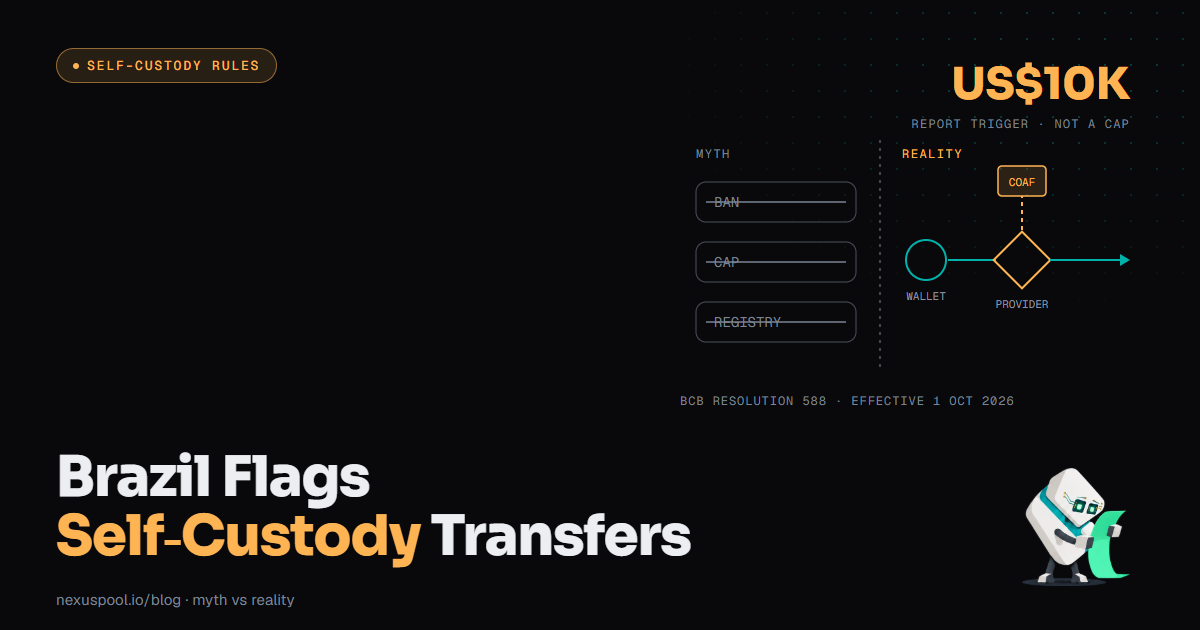
On September 23, 2026, Brazil's central bank published new anti-money-laundering rules for crypto companies operating in the country. Buried in the technical language of BCB Resolution No. 588 was a line that spread fast through Bitcoin circles: starting October 1, 2026, transfers worth the equivalent of US$10,000 or more moving to or from a self-custody wallet have to be reported to COAF, Brazil's financial-intelligence unit, by the next business day, according to Bitcoin.com News' report on the requirement. Within a day, headlines were calling it a crackdown on self-custody. Some were not far off. Others got the mechanics wrong in ways you should care about if you hold your own keys, in Brazil or anywhere else the Brazil self-custody crypto reporting rule is now a reference point.
This is a new kind of story for anyone who cares about non-custodial design, because a national regulator has written self-custody directly into a compliance framework instead of treating it as something outside the system. Below, each popular claim sits next to what the text says.
Myth: Brazil Just Banned Self-Custody Wallets
Reality: it did not. Resolution 588 does not stop anyone from generating a seed phrase, running their own node, or holding Bitcoin, Litecoin, or any other asset in a wallet where only they hold the private key. Brazilians remain free to self-custody in whatever amount they choose. The change is a reporting obligation on virtual asset service providers (exchanges and other platforms authorized by the central bank), not on individual wallet holders. If an authorized provider processes a transfer of US$10,000 or more that touches a self-custody address, that provider now has to tell COAF about it. The wallet holder does not file anything themselves. The restriction that does bite lands on the platforms: a companion rule, Resolution 589, bars authorized providers from dealing with unauthorized ones from the same October 1 date.
Myth: There's a New $10,000 Cap on What You Can Move
Reality: US$10,000 is a reporting trigger, not a ceiling. You can send $50,000 out to a self-custody wallet in one transaction if a provider is willing to process it; the transfer just gets reported once it clears that threshold, the same way large cash transactions get reported under decades-old banking rules in most countries. Nothing in the resolution limits transaction size, frequency, or destination. The report is automatic once the value is reached and does not depend on anything looking suspicious, and it sits alongside the separate duty to flag suspicious activity at any size.
Myth: Your Wallet Now Has to Register With the Government
Reality: there is no wallet registration step. COAF receives a report about a transaction, tied to the provider's records and the customer who initiated it; nobody has to enroll the receiving address anywhere. That does not make the rule harmless for privacy. Each report names a self-custody address next to a known customer, so over time COAF could assemble a map of which exchange users control which addresses, a point Bitcoin.com's coverage raises. The accurate version is narrower than "registration" and still worth taking seriously: one specific movement of funds gets logged because of its size, and those logs can add up.
| Claim making the rounds | What Resolution 588 actually does |
|---|---|
| "Self-custody is now illegal in Brazil" | Self-custody remains fully legal; only provider-side reporting changed |
| "You can't move more than $10K yourself" | US$10K is the report trigger, not a transfer limit |
| "Wallets must register with COAF" | No wallet registry step exists, but each report ties an address to a customer |
| "This only affects Brazilian residents" | It binds providers authorized by Brazil's central bank, and the question it answers is being asked elsewhere too |
Myth: This Is Only a Brazil Story
Reality: it is one data point in a pattern. On September 14, the SEC's chairman used a speech to point staff toward a framework letting investment advisers self-custody client crypto. Three days later, CFTC staff issued a no-action letter extending relief to software that passively lets self-custodial wallets interact with regulated derivatives. These came from different bodies with different aims, but all three land on the same underlying question: how should a financial system built on intermediaries treat a technology whose entire design goal is removing the intermediary. Brazil's answer was closer monitoring of the handoff points. If you hold your own keys, the direction of travel across these regulators tells you more than any single country's threshold.
Why Brazil's Self-Custody Rule Matters for Solo Miners
A regulator asking "how much moved from a platform into a wallet only the user controls" is asking a question that assumes a handoff happens somewhere: money sits with an exchange or a pool, then gets pulled out into self-custody. That handoff is exactly the step NexusPool's technology page describes the pool as skipping. When a rig connected to NexusPool finds a block, the coinbase transaction that pays out the subsidy and fees pays the miner's own address directly, inside the block itself. There is no pool-held balance that later gets withdrawn into a personal wallet, because the address that receives the reward was the miner's self-custody address from the first confirmation. As the technology page puts it: the block pays your address, and there is no balance for us to hold. With a 0% pool fee in solo mode, the Payout Preflight tool lets a miner see the exact coinbase that would pay their address on the current block before they ever find one, so there is nothing to reconstruct after the fact if a regulator, or anyone else, asks where funds moved.
None of this makes solo mining a way around reporting rules that might apply to a Brazilian miner's other crypto activity, and none of it is tax or legal advice. Selling mined coins through an authorized exchange is still a transfer between a self-custody wallet and a provider, and whether a specific transaction gets reported under Resolution 588 depends on facts this post cannot know for any individual reader. A pool's design also does nothing to a miner's odds of finding a block, which are set by hashrate against network difficulty and are the same at every pool. What can be said honestly is narrower: a payout structure that never routes through a pool-held balance has one less handoff for anyone, regulator or otherwise, to ask about later.
The Reality, in Short
Brazil did not outlaw holding your own keys. It told the platforms it authorizes to flag large transfers touching self-custody wallets, the way large transfers have long been flagged elsewhere in finance, and it did so in the same month two separate US regulators floated their own, friendlier framings of the same question. You should get this rule right because self-custody's whole appeal is that no institution gets to define what you can do with your keys. Getting the mechanics wrong (assuming a ban, a cap, or a registration step that doesn't exist) hands that definition to a headline instead of the actual text, and missing the part that is real (a growing record of which customers control which addresses) hands it to wishful thinking.
Trust nothing. Verify what Brazil's new rule actually requires before you assume it changes anything about how you hold your own coins.