Bitcoin Miners
Can Miners Connect Without Accounts? Yes.
Can miners connect without accounts? Yes. Connect with a Bitcoin address, set a worker label, and check where a found block pays before mining on-chain.
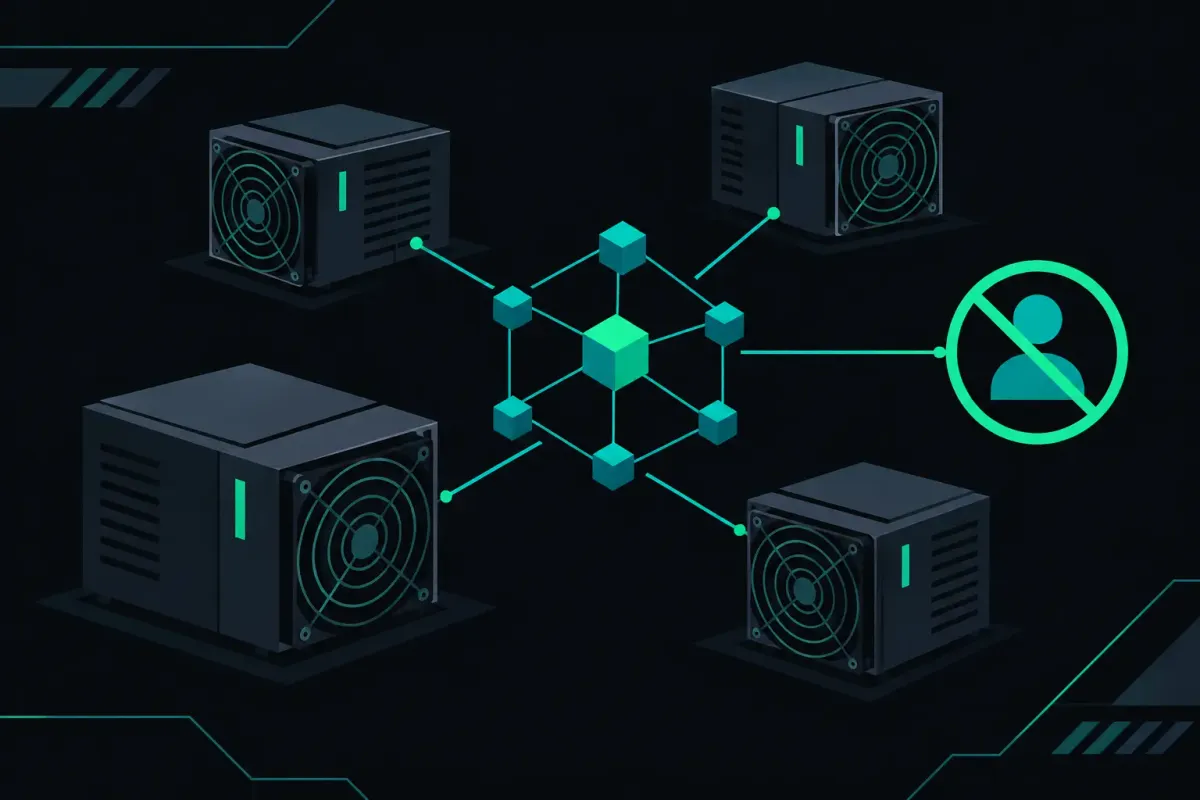
A solo miner should not need a customer account to tell a pool where a block reward belongs. Can miners connect without accounts? Yes. The connection can carry a Bitcoin address as the payout instruction. If the rig finds a valid block, that address is written into the block's coinbase transaction.
That is different from a balance held under a username. There is no pool balance waiting for a withdrawal. There is no payout threshold. There is no request for identity documents before a machine can submit work. The address is the destination.
NexusPool (nexuspool.io) accepts Bitcoin connections at solo.nexuspool.io:3350. A miner can use Stratum V1 or encrypted Stratum V2 on that same port. Most home mining hardware still uses Stratum V1, so this is usually a normal pool setup with one material difference: the worker identity is the Bitcoin address that receives a found block.
What an accountless mining connection does
A pool still needs a few facts from a rig. It needs to know where to send work. It needs a payout address for a valid block. It needs enough connection information to return responses to the rig. None of those facts require an account.
In an account-based arrangement, a pool commonly associates shares, balances, workers, and payout settings with a login. In an address-based solo connection, the address is attached to the mining session as the payout instruction. The pool can count work from that rig without first creating a customer balance.
The distinction matters most at the moment a block is found. Bitcoin records the output in the block itself. The block subsidy and the transaction fees go to the address specified in that block. They do not first sit in a pool wallet for later distribution.
That does not make a Bitcoin address a username in every sense. An address tells the network where a transaction output can be spent. It does not prove who controls it to the pool. It also does not give you a recovery path if you paste it incorrectly. Check the address before starting the miner. A valid-looking address that you do not control is still a valid destination.
Can miners connect without accounts on a home rig?
For a home miner, the connection path is short. Open the rig's pool settings and enter solo.nexuspool.io as the host and 3350 as the port. Put a Bitcoin address you control in the worker or username field. If the firmware requires a password field, follow the firmware's required format. That field is not an account password.
The exact labels vary. One firmware may say Pool URL and Worker. Another may say Server, Username, and Password. The important part is not the label. It is that the payout address entered for the connection is the address you intend to use.
A worker label can still be useful when firmware supports it. A label helps distinguish one machine from another in the rig's own configuration. It should not replace the payout address. If you operate several machines, keep a local record of which address and label each machine uses. Your router, miner interface, and configuration backup are better places for that inventory than memory.
For standard Stratum V1 hardware, use the normal Stratum setup screen. For hardware that supports Stratum V2, the same endpoint accepts the encrypted protocol. Do not assume your miner supports V2 because its firmware menu mentions it. Many compact home miners do not. A working V1 connection is still a valid connection.
Check the payout before you point hashrate
An accountless setup removes the login step. It does not remove the need to verify the destination.
Payout Preflight shows the payout constructed for your address on the current block before your rig finds anything. It gives a miner a concrete thing to inspect: the output address and the reward that would be paid by that candidate block. This is the useful check before mining, because it examines the transaction structure rather than asking you to trust an account page.
The word “current” matters. A Bitcoin block template changes as new transactions arrive, fees change, or another block reaches the network. The subsidy follows Bitcoin's rules. Transaction fees belong to the particular block that is eventually found. A preflight check shows the payout for the candidate at that time. It is not a promise that a later candidate will contain the same fees.
If the displayed address is wrong, stop there. Fix the rig configuration before it begins working. A miner cannot correct a coinbase output after a block has been found and accepted.
No account does not mean no mining protocol
Accountless does not mean anonymous magic. The rig and pool still exchange mining jobs and submitted shares over a network connection. The pool has to decide whether a submitted share meets the assigned target. The rig needs to learn when it should work on a new block.
Those details matter because a solo miner is not buying a chance from the pool. Network difficulty sets the odds of finding a Bitcoin block. The odds are the same at every pool for the same hashrate. Solo mining is a lottery, and an average waiting time is not a schedule.
What the connection path can affect is whether the rig receives current work, whether its submitted work is read correctly, and whether a valid found block is delivered to the Bitcoin network. Those are operational questions, not luck claims.
For Bitcoin, the endpoint steers connections to a nearby healthy region among Los Angeles, Chicago, Frankfurt, and Singapore. A miner far from those regions has a longer network round trip. That can delay new work and status information. It does not change the miner's block-finding odds.
The pool reads shares in the form the rig firmware submitted them and provides a reason when it reads or rejects a share. It also holds a rig's assigned difficulty when the rig goes quiet for a few minutes. That avoids treating a short interruption as a reason to abruptly reset the connection's work level.
When a valid block is found through Los Angeles, Chicago, or Frankfurt, it is written to disk and then sent to Bitcoin nodes in all three cities, with retries for up to five minutes. A block found through Singapore is sent to its local node. After a restart, a pending block is submitted again. The limits are part of the design. Singapore is not described as a three-city broadcast path because it is not one.
What you give up, and what you keep
An account can be convenient for changing settings from a web page, grouping machines under one login, or receiving a conventional balance statement. An accountless connection puts more responsibility on the miner instead.
You must control the private keys for the address you enter. You must save your own configuration. You must check that the address is correct after a firmware reset, a configuration import, or a machine swap. If you rotate to a new address, update the miner before its next connection.
What you keep is direct payout construction. A found block is not credited to an internal ledger and then paid later. The payout destination is part of the block your rig found.
For operators who want evidence about counted work without creating an account, the pool signs one receipt per rig per hour. The receipt can be checked with the published signing key using a BIP340-capable library. Los Angeles also timestamps new receipts in Bitcoin. This is not a replacement for watching your miner's local status. It is a separate record of what the pool counted for that rig during that hour.
A simple test before mining
Use an address from a wallet you control. Enter it in the miner's worker field. Point the rig at solo.nexuspool.io:3350. Then run Payout Preflight and compare the displayed destination with your intended address character by character.
That is the useful accountless test. It does not predict when a solo miner will find a block. Nothing can provide that schedule. It checks where the whole reward is constructed to go if the rig does.
Trust nothing. Verify your payout address before you mine.