CLARITY Act
CLARITY Act Failed: What Bitcoin Miners Still Have
The Senate blocked the CLARITY Act 49-50. See which mining protections died with it, what stays legal, and five checks for your own payout path.
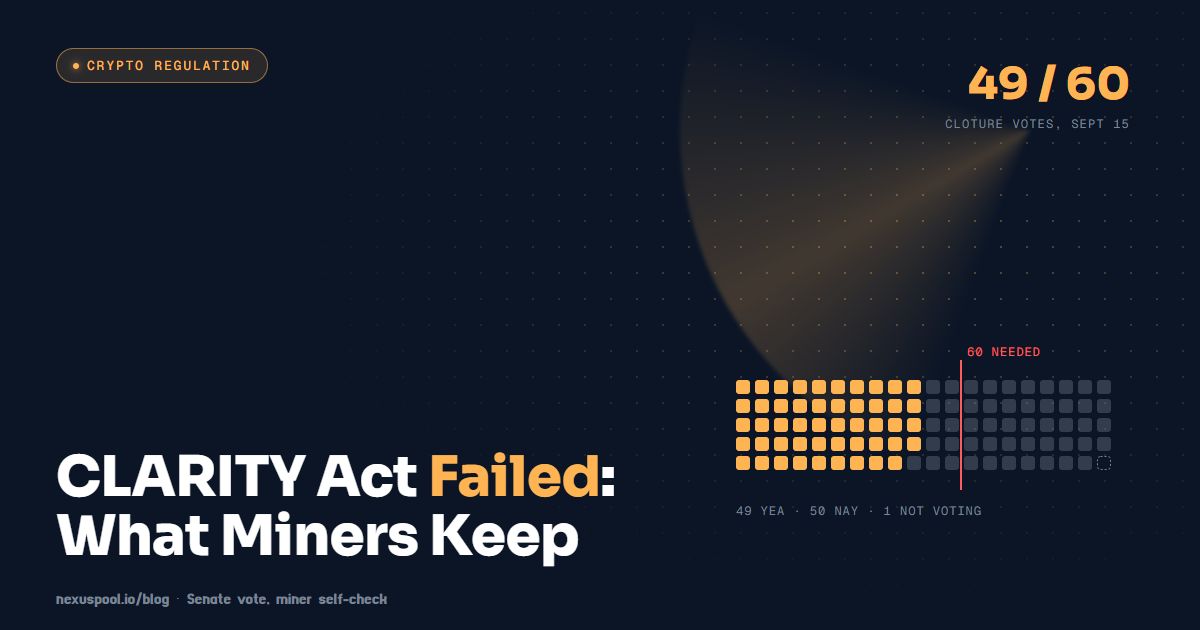
Shortly after 2 p.m. Eastern on Tuesday, September 15, the Senate voted 49 to 50 on whether to even begin debating the Digital Asset Market Clarity Act. The motion needed 60. By Wednesday morning Bitcoin had slipped below $76,000, and spot Bitcoin ETFs had shed $450.4 million in a single session, their largest daily outflow since June 24. If you mine, the headline number matters less than a quieter one: the two sections of that bill written for you never became law. This self-check walks through what the CLARITY Act failure takes off the table for Bitcoin miners, what stays exactly where it was, and five questions you can answer about your own setup today.
What Happened in the CLARITY Act Cloture Vote
Tuesday's roll call was a cloture vote on the motion to proceed to H.R. 3633, the House-passed bill carrying the Senate's final substitute text. All 49 yes votes came from Republicans. Susan Collins, Josh Hawley and Jerry Moran voted no. Thom Tillis, who supports the bill, switched his vote to no so he could file a motion to reconsider, because Senate rules only let a senator on the prevailing side make that motion. Chris Coons did not vote. No Democrat or independent voted yes, including the senators who negotiated the text.
The count adds up cleanly. Republicans hold 53 seats: 49 yeas plus 4 nays. The other 47 seats produced 46 nays and one absence. Even with all 53 Republicans on board, the sponsors still needed 7 Democrats, and they got none. According to CNBC's report on the vote, Senator Cynthia Lummis had told reporters earlier that day that "it's over" if the procedural vote failed. The sticking point was ethics language limiting officials' crypto income, not the split between the SEC and the CFTC.
The Mining Protections That Did Not Pass
The final text carried two pieces aimed at people who run hashrate. Section 10601 said nobody becomes subject to the Securities Act or the Exchange Act "solely based on" certain network activities, and one item on that list read "providing computational work." Section 20209 repeated the list for the Commodity Exchange Act. Section 10604, the Blockchain Regulatory Certainty Act, protected a "non-controlling developer or provider" from money transmitter registration if it lacked the unilateral ability to move digital assets its users were entitled to.
For a solo miner, those sections would have put in statute something that today rests on agency statements and guidance. For a pool, Section 10604 would have drawn a legal line between an operator that holds your coins and one that cannot touch them. None of that exists in federal law this morning.
What the Failed Vote Leaves Exactly As It Was
Mining Bitcoin stayed legal on Monday and it stays legal today. In March 2025 the SEC's Division of Corporation Finance published a staff statement saying proof-of-work mining, both self-mining and pool participation, does not involve the offer or sale of securities. That statement still stands. It carries less weight than a statute: staff views bind no court, and a future commission can withdraw them. Money transmission questions for pools go back to existing FinCEN guidance and state law, the same place they sat last week.
Your taxes did not move either. The CLARITY Act never touched how the IRS treats a block reward; that debate runs through a separate House bill. Difficulty, the halving schedule and consensus rules stay untouched. And the vote changed nothing about your odds. Your chance of finding a block equals your hashrate divided by the network's hashrate, identical at every pool, custodial or non-custodial, with or without a law in Washington.
Is the CLARITY Act Dead?
It is shelved, not formally buried. Tillis's motion to reconsider sits pending, and the majority leader can call up a second cloture vote whenever he thinks he has 60. The calendar works against that. CNBC reports the Senate plans to leave Washington in early October and stay out until after the midterm election seven weeks from now, and the House heads home at the end of this week. In the meantime, the SEC and CFTC keep writing rules on their own, and rules written by agencies can be rewritten by the next administration.
Five Questions to Check Your Own Setup
You cannot vote on cloture, but you can check the parts of your mining that no bill was going to fix for you.
- Does your pool ever hold your coins? Section 10604's test asked whether an operator can move funds you are entitled to. The test did not become law, but the risk it described is real. A custodial pool credits an internal balance and pays you later from wallets it controls. A non-custodial solo pool writes your address into the coinbase transaction, so the block reward lands with you in the block itself.
- Can you see that before you find a block? On NexusPool, the Payout Preflight tool rebuilds the exact coinbase transaction the pool would pay to your address against the live block template. You check the output yourself instead of reading a promise.
- Can you verify the pool's work claims offline? Glass Ledger signs custody and work receipts that you can check without trusting the pool's own dashboard.
- Do you know which path your hashrate takes? The technology page documents the Stratum V1 and Stratum V2 connections, and the terms state what the software does and does not do.
- Are you tracking the right fights? For miners, the live items are the pending motion to reconsider, the SEC and CFTC rulemaking that fills the gap, and the separate tax bill. Prices will react to all three. Your odds will react to none.
A caution. This post describes a bill that did not pass and statements that could change. It is not legal, tax or investment advice about how any operator, including NexusPool, would be classified under any future law, and NexusPool's core software is not open source.
Your CLARITY Act Self-Check, Scored
If your pool pays your address directly in the coinbase, you can confirm that output before a block arrives, and you understand that no pool changes your odds, the failed vote changes very little in how you mine. You lost a statute that would have written protections down. You kept the design choice that made those protections relevant: never letting an operator hold what you earn. If any of the five answers came back "I don't know," fix that first. Congress may take another vote this fall or wait until 2027, and your payout path should not depend on which.
Trust nothing. Verify where your coinbase sends the reward, whatever the Senate does next.