Glass Ledger
A Mining Pool's Bankruptcy, By the Numbers
A pool that once ranked among Bitcoin's biggest owes $173.1M in Chapter 11, mostly to frozen wallet holders. What the numbers mean for your pool.
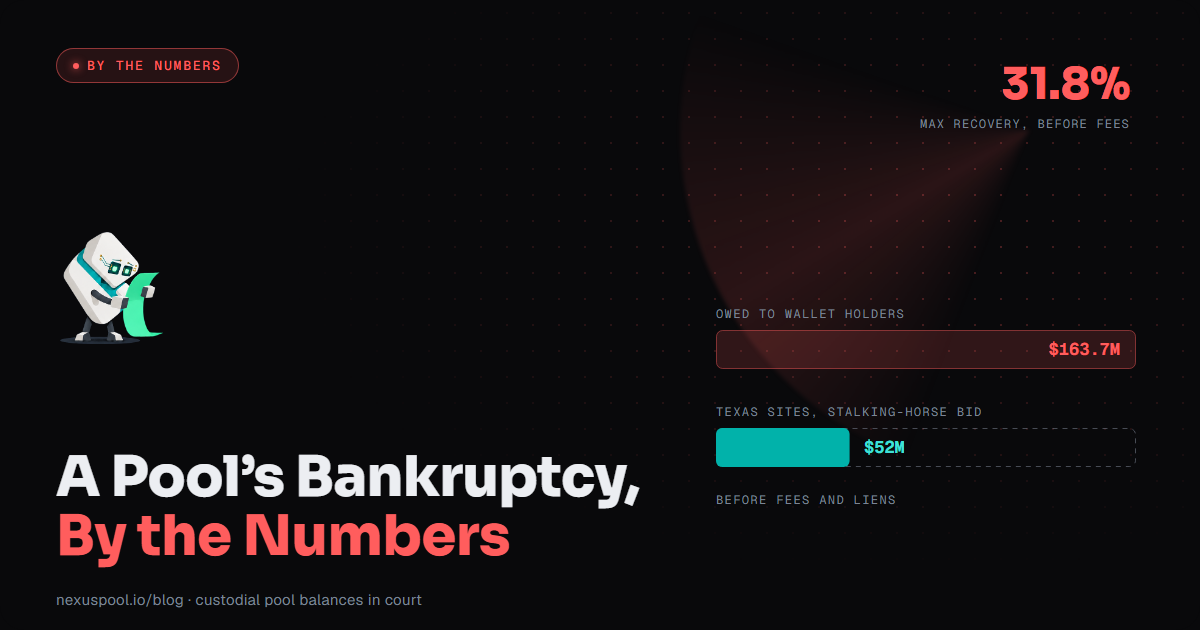
On July 22, 2026, a mining pool operator and two US affiliates filed for Chapter 11 bankruptcy in the US Bankruptcy Court for the District of New Jersey. Its pool was once one of the largest Bitcoin mining pools in the world, near 18% of global hashrate around 2020. Now its last two West Texas mining sites are up for sale, with a sale hearing set for September 18, and most of what the company owes sits with people who left crypto in its wallet four years ago. The bankruptcy reads more clearly through its numbers than through its filings.
$173.1 Million: What the Bankruptcy Owes
The filing lists roughly $173.1 million in total obligations against assets of $1 million to $10 million. The biggest slice, about $163.7 million, is owed to roughly 11,700 wallet holders with balances above $100. A further $3.5 million to $4.3 million is an unsecured loan from the company's founder, and around $9.4 million covers other claims.
The wallet holders are not new creditors. In September 2022, the company froze withdrawals from its Wallet and Pool Account products after a lending and yield business it ran beside the pool got into trouble. Miners who had let pool earnings sit in those accounts could no longer take them out. It later converted frozen balances into IOU tokens instead of paying them back in crypto. By the time of the July filing, that money had been locked for close to four years.
2021 and 2022: The Two Years Behind the Bankruptcy
According to Law360's reporting, cited in summaries of the case, two events drove the company into Chapter 11: China's 2021 ban on mining, which cut away much of the hashrate a Beijing-founded pool depended on, and the 2022 liquidity crisis inside its wallet-deposit business. Neither involved a hack. The pool's mining side kept working through the freeze, because affected miners pointed their machines at other pools within days. Their hashrate moved easily. Their balances did not.
That split is the lesson for anyone mining today. Hashrate is portable: you change a stratum URL and you are gone. A balance held by the pool is not portable. Once the company behind it stops processing withdrawals, you hold a claim, and the claim waits in line.
Unsecured: Where Wallet Holders Stand in Line
In the bankruptcy, wallet IOU claims rank as unsecured. They are not a property claim on specific coins, so they sit behind any liens on the company's remaining assets and behind the case's own administrative costs, including the lawyers, the crisis manager and the claims agent. Crypto custodian bankruptcies move slowly. Celsius took about eighteen months from filing to its first distributions, and Mt. Gox took about a decade.
For the 11,700 wallet holders, that means the question is no longer whether they get their coins back. The question is what percentage of a dollar figure they recover, and when.
$52 Million: The Floor Price for What Is Left
Thor CALAP LLC signed on as stalking-horse bidder for both Texas sites: $37 million for Tarbush and $15 million for Pyote, $52 million in total. The court approved bidding procedures on August 17, with qualified bids due September 8 and an auction set for September 10 if anyone topped the stalking horse. The sale hearing follows on September 18, with a target closing by November 30. CoinDesk's report on the filing covers how the pool that once led Bitcoin mining ended up selling its last sites to pay creditors.
The ceiling on recovery follows from simple division. $52 million over the $163.7 million owed to wallet holders is 31.8%. Spread across the full $173.1 million in obligations, it is 30.0%. Both figures come before fees, liens and the time value of waiting. A competing bid could lift them a little. Nothing in the case suggests anyone gets close to 100 cents on the dollar.
0: The Balance a Non-Custodial Pool Holds for You
Now set these numbers against a design where the pool never holds a balance at all. NexusPool runs as a non-custodial solo pool with a 0% fee: when you find a block, the coinbase transaction pays 100% of the reward to your own address inside the block itself. No internal account fills up between payouts, so no freeze can lock it and no court can divide it among creditors. The Payout Preflight tool rebuilds that coinbase against the live block template so you can see your address in the output before a block arrives, and Glass Ledger signs a receipt each hour for the work the pool counted, which you can check against the key NexusPool publishes.
That design does one thing and only one thing. It removes the counterparty balance. It does not change your odds of finding a block. Those odds come from the network's difficulty and your hashrate, identical at every pool, custodial or non-custodial, large or small. Solo mining stays a lottery, and a pool that tells you otherwise is selling something.
What the Numbers Mean for Your Own Pool
Run your current pool through the same arithmetic these wallet holders now live with. How big is the balance your pool holds for you on an average day? How often does it pay out, and can it delay payouts on its own authority? Does it run any lending, yield or wallet business next to the pool, the way this one did? If the operator froze withdrawals tomorrow, what number would you be writing on a claim form?
If those answers make you uneasy, NexusPool's technology page documents how Stratum V1 and Stratum V2 connections route rewards to your address for Bitcoin, Litecoin, Dogecoin and Bitcoin Cash. This is not investment or legal advice, and it is no claim that any pool can improve your chance of finding a block. It is a count of where the money sits between the moment a block is found and the moment it reaches a wallet you control.
Trust nothing. Verify where your payout goes before a bankruptcy court has to tell you.