How Direct Block Payouts Reach Your Address
Direct block payouts send a solo-mined Bitcoin block reward to your own address in the block. See what to check before you point your rig. Verify it now.
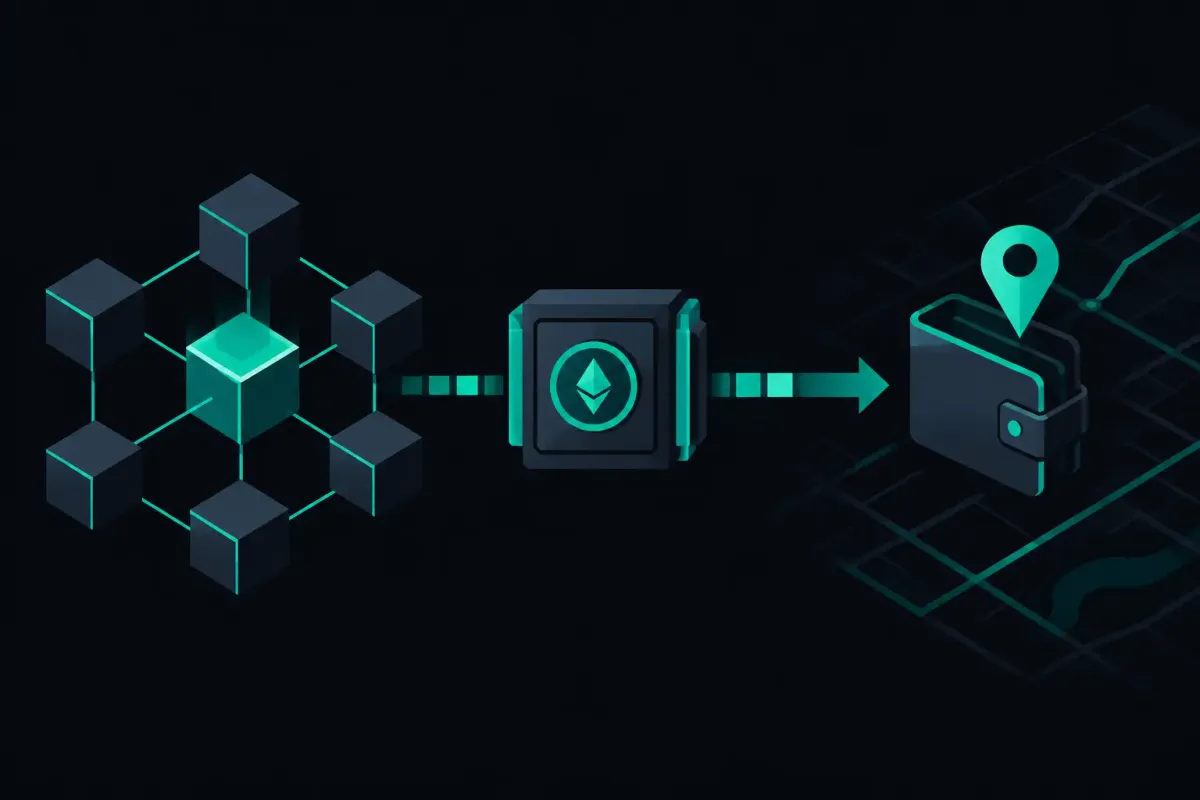
A solo miner does not need a pool balance to receive a winning block. With direct block payouts, the Bitcoin address you mine with is written into the block your rig finds. The block subsidy and its transaction fees go there in the coinbase transaction. There is no account balance to request. There is no later pool payout to wait for.
That is the useful meaning of direct. It describes where the reward is created, not a promise about when a rig will find it. Network difficulty sets the odds at every pool. Solo mining is a lottery, and an average wait is not a schedule.
What direct block payouts mean
Every valid Bitcoin block contains a special first transaction called the coinbase transaction. It creates the block subsidy and collects the fees from the transactions included in that block. A direct payout puts the miner's Bitcoin address in an output of that transaction.
If your rig finds the valid block, anyone can inspect the block and see the destination address and amount. The reward does not first become a number in a pool database. It exists on-chain in the block itself.
This is different from a payment that happens after a block is found. A later payment can still be visible on-chain, but it starts with a pool-held balance and depends on the pool sending another transaction. A direct block payout starts at your address.
The coins are not immediately spendable. Bitcoin coinbase outputs mature after 100 more blocks are added to the chain. That rule comes from Bitcoin, not from a pool. Direct refers to the destination of the reward, not instant spendability.
The value also depends on the block that is actually found. The subsidy is fixed by Bitcoin's issuance schedule at that height. Transaction fees depend on the transactions in the winning block. A screen that shows a projected payout should therefore identify the address and the current block it was built for, rather than presenting a fixed future amount.
The check that matters before you mine
For a home miner, the first check is plain: enter a Bitcoin address you control, then confirm the pool is preparing a payout for that same address. Do this before worrying about dashboards, charts, or a distant average.
NexusPool (nexuspool.io) calls this Payout Preflight. It shows the payout constructed for your address on the current block before your rig finds anything. The practical question is not whether a page says "0%" or "non-custodial." It is whether you can inspect the address that would receive a found block before you send work.
A useful preflight view should let you check three things together. First, it should show your exact Bitcoin address, not a shortened label that could hide a typo. Second, it should state that the payout is for the current block, because templates change when the network advances. Third, it should show the subsidy and the fees that make up the displayed total.
Keep control of the address. A pool cannot help recover coins sent to an address whose private key you do not hold. If you use an exchange deposit address, the block can still pay there, but you have added the exchange's deposit policy to a payment that otherwise needs no account. A wallet address under your own control keeps the arrangement simpler.
Connect the rig, then verify the path
For Bitcoin, point the miner at solo.nexuspool.io:3350 and use your Bitcoin address as the connection identity. There is no account, sign-up gate, or KYC step. The same port accepts Stratum V1 and encrypted Stratum V2, so a typical home rig can use the protocol it already supports.
Connection is not the same as a found block. Your miner will submit shares to show that it is working on the assigned job. Most shares are not blocks. A block is found only when one hash also meets Bitcoin's network target.
That distinction matters when reading miner logs. A share accepted by the pool is evidence that the rig completed assigned work. It is not a fraction of a future block reward in solo mining. A rejected share needs a reason, especially if you are diagnosing a new setup or an unstable connection.
NexusPool reads shares as the firmware wrote them and gives a rig a reason for the shares it reads and rejects. It also holds a rig's difficulty when the rig goes quiet for a few minutes. That avoids treating a short interruption as a reason to immediately change the work target. It does not change the network target, and it does not change your odds.
If you are far from Los Angeles, Chicago, Frankfurt, or Singapore, the round trip to the server can be longer. That can delay when your rig receives new work or when it sees status updates. It does not alter the probability that a given hash meets Bitcoin's target. Distance affects timing. Hashrate and network difficulty set the odds.
Why the route from hash to block still matters
A direct payout only helps if the winning work is handled correctly. There are several points between a rig and the Bitcoin network where a result can be delayed, misread, or fail to reach nodes.
New work is one point. When the network announces a new block, mining on the old tip becomes stale as the rest of the network moves on. On NexusPool's Frankfurt server, the median time from a new block header to work was 0.49 ms across 162 mainnet blocks measured on September 10 and 11, 2026. That work was ready 205 ms before the local node finished validating the new block. The first job carries no transactions, because validation is not complete yet.
That measurement has a limit. It is from Frankfurt, on those dates and that sample. It does not describe every server, every network condition, or every chain. It shows a mechanism and a measurement you can question, not a claim that a pool changes mining luck.
Found-block handling is another point. For a block found through Los Angeles, Chicago, or Frankfurt, the pool writes it to disk first and then sends it to Bitcoin nodes in all three cities. Each send is retried for up to five minutes. A pending block is submitted again after a restart. A block found through Singapore is sent to its own node only.
Those details do not make a winning hash more likely. They address what happens after one exists. If a rig never produces a network-valid hash, no payout design can create one. If it does, the route to publication becomes relevant very quickly.
What to look for after a block is found
If your rig finds a block, the first verification is the block itself. Find the coinbase transaction in the accepted block and inspect its outputs. Confirm that your address appears there. Confirm that the output value matches the subsidy plus the transaction fees for that block, subject to the transaction's output structure.
Then wait for maturity before trying to spend the coins. During that period, you can watch confirmations accumulate on the chain. You do not need to trust an account ledger to learn whether the reward exists or where it was sent.
Do not confuse a found-block payout with regular income. A lower network difficulty means a shorter expected wait at a given hashrate. It does not mean more value, and it does not put a date on a win. The next valid block could arrive quickly, late, or not within the life of a small miner.
That uncertainty is the whole solo-mining trade. Direct block payouts do not soften it. They make one part of the result plain: if your rig finds a valid block, you can check where the reward lands before mining and inspect it again in the block afterward.
Before pointing a rig at a solo endpoint, verify the address in the payout preflight. If you win, verify that same address in the coinbase transaction.