Dogecoin Mining
DOGE-1 Launch: Dogecoin Mining, Myth vs Reality
Dogecoin's DOGE-1 satellite is set to launch. Here is the myth vs reality of how Dogecoin is mined, secured through Litecoin, and solo-mined.
Dogecoin is having a moment that has nothing to do with mining. DOGE-1, a small lunar CubeSat that Geometric Energy Corporation paid for in Dogecoin, is targeted to lift off around September 14 on a SpaceX Falcon 9, five years after its 2021 announcement and several delays later. Launch dates slip, so treat that as a target until the rocket leaves the pad. The mission gives "Dogecoin to the moon" a literal meaning, and it gets far more attention than the Scrypt hashrate securing every Dogecoin block. That hashrate arrives through Dogecoin merged mining, and the mechanism looks nothing like what most people assume.
Myth: Dogecoin Has Its Own Army of Dedicated Miners
The common assumption is that Dogecoin works like Bitcoin, with a global fleet of machines pointed only at DOGE's blockchain, competing for DOGE block rewards alone.
Reality: Dogecoin Merged Mining Borrows Litecoin's Scrypt Hashrate
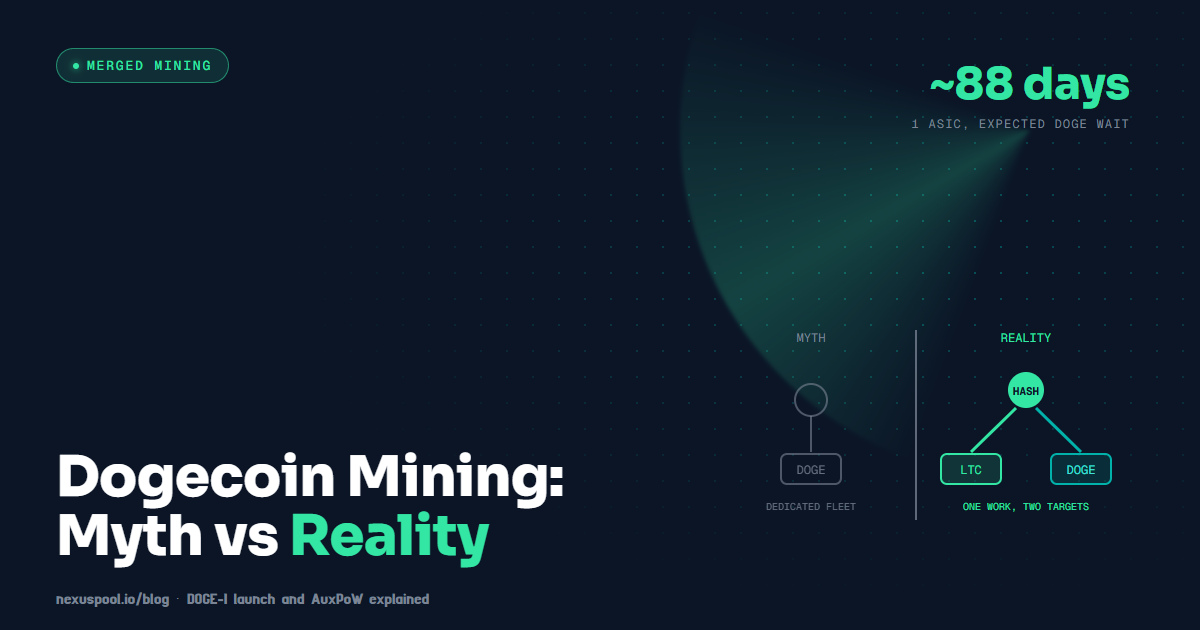
Since 2014, Dogecoin has accepted Auxiliary Proof of Work, AuxPoW for short, which lets it merge mine alongside Litecoin. A miner running Scrypt hardware works on a Litecoin block as normal, and the Litecoin coinbase carries a commitment to a Dogecoin block. When a hash meets Dogecoin's difficulty target, the miner submits it to Dogecoin as a valid block. Nobody runs two machines or splits their hashrate: the Litecoin work and the Dogecoin work are one computation checked against two targets.
Not every Litecoin miner merges Dogecoin in, and the live numbers show it. From the current difficulty, Dogecoin's network works out to about 1.9 PH/s against roughly 2.6 PH/s for Litecoin, so around 72% of Litecoin's Scrypt power also secures Dogecoin. That shared hashrate is why Dogecoin's security held up after miners stopped caring about DOGE on its own years ago.
Myth: Solo Mining an Altcoin Takes Centuries, Like Solo Bitcoin Mining
Home solo mining talk anchors on Bitcoin, where a small device can expect to wait thousands of years for a block, because Bitcoin's network hashrate sits in the hundreds of exahashes.
Reality: Dogecoin's Own Numbers Are a Different Order of Magnitude
Dogecoin's network hashrate is a tiny fraction of Bitcoin's, and it produces a block every minute instead of every ten. Here is the math with both inputs stated, for one Scrypt ASIC.
| Input | Value |
|---|---|
| Example device hashrate | 15 GH/s (one Antminer L9, 15 GH/s model) |
| Dogecoin network hashrate | about 1,900,000 GH/s (1.9 PH/s), derived from difficulty 26.58 million on September 14, 2026 |
| Per-block probability | 15 ÷ 1,900,000 = 1 in 126,667 |
| Dogecoin blocks per year | about 525,600, at a 1-minute target block time |
| Expected wait | 126,667 ÷ 525,600 = 0.24 years, about 88 days |
That is not a promise of a block in three months. It is an expected value, the average across many identical attempts, and any single run can land far earlier or far later. CoinWarz's Dogecoin hashrate tracker publishes a live network figure, and you should check the day's number before you run this formula, because it moves daily. The math is the same at every pool: your odds are your hashrate divided by the network's, and no pool, fee model, or custody setup changes them. On a merged setup the same machine also carries Litecoin odds at the same moment, computed the same way against Litecoin's own network hashrate and its 2.5-minute blocks.
Myth: A Mining Pool Holds Your DOGE Until You Withdraw It
Custodial pool balances are common enough that many miners assume that is how every pool works: mine, build a balance on the pool's books, request a withdrawal later.
Reality: A Non-Custodial Pool Never Takes Custody
On a non-custodial setup like NexusPool's Litecoin pool with Dogecoin merged in, you supply a Litecoin address and a Dogecoin address, and any block reward goes on-chain to those addresses. The pool holds no balance, so you have nothing to withdraw. That structure matters more with merged mining, not less. Litecoin's target is harder than Dogecoin's (difficulty about 91.9 million against 26.6 million), so a hash that wins a Litecoin block almost always wins a Dogecoin block too, and one lucky share can pay out on two chains. A custodial pool sitting between you and two payouts is two places for something to go wrong instead of one. NexusPool's Litecoin technology page covers the Stratum V1 and Stratum V2 details behind that AuxPoW connection, and the Glass Ledger signs custody receipts you can check offline instead of trusting a dashboard.
Try the Math Yourself
The table uses fixed example numbers. To plug in your own device and the day's network figure, paste the self-contained calculator below into Ghost's HTML card (the /html card in the editor, not a text card), since it runs JavaScript:
Without the HTML card, the formula works by hand: divide the network hashrate by your device hashrate, then divide that result by the chain's blocks per year (525,600 for Dogecoin, 210,240 for Litecoin).
The Reality, In Short
Dogecoin's security comes from Scrypt hashrate merged in from Litecoin, not a DOGE-only fleet; a single home ASIC's expected wait for a Dogecoin block is measured in months, not centuries; and a non-custodial pool never holds a balance on either chain. None of this is investment advice, no figure here promises a payout on any timeline, and nothing here claims NexusPool's core software is open source, because it is not. Trust nothing. Verify the hashrate numbers behind whatever chain you point your hardware at today.