Glass Ledger
Dogecoin and Litecoin Difficulty Surge, By the Numbers
Dogecoin difficulty jumped over 10% in a month as new efficient scrypt hardware hits the network. Here is what that actually does to solo merged mining odds.
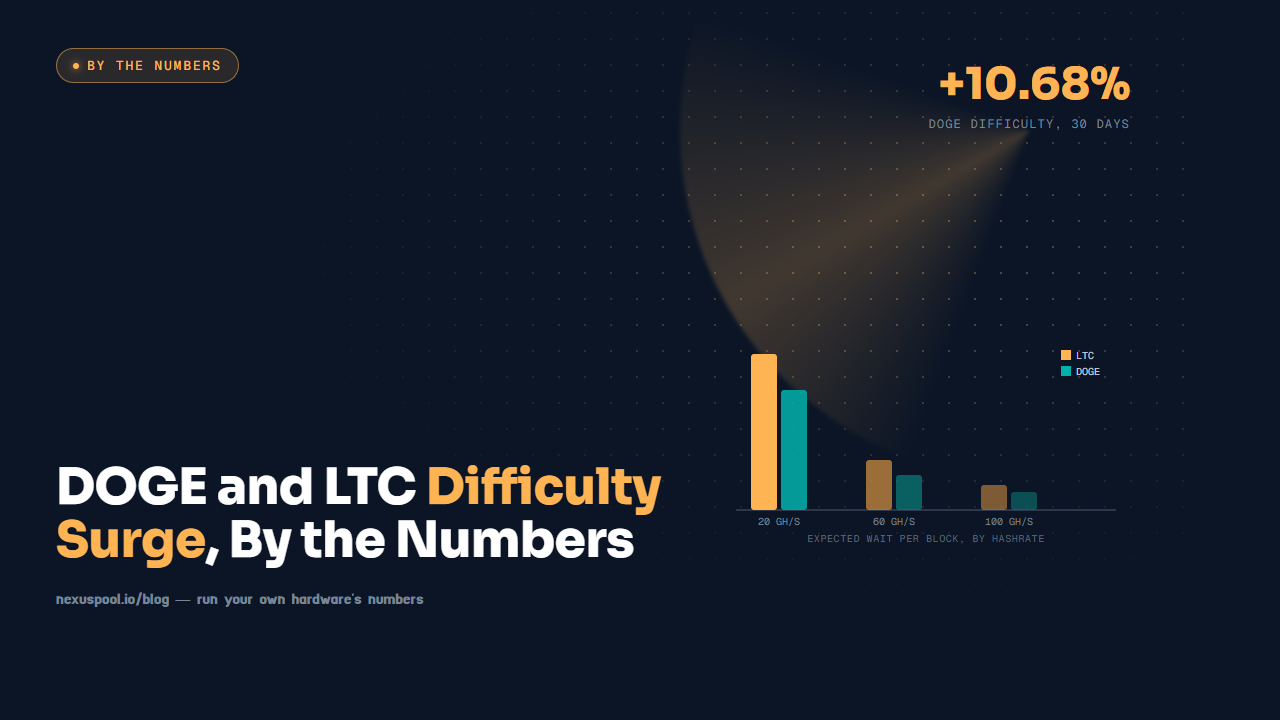
10.68 percent. That is roughly how much Dogecoin's mining difficulty climbed over the 30 days leading into late August 2026, with a single-day jump of 6.39 percent inside that window, according to network data reported in mid-August. Litecoin's own hashrate has been sitting near 2.53 petahashes per second as of August 25, 2026, after pulling back from an earlier record. A Dogecoin Litecoin difficulty surge 2026 headline like that usually gets read as bad news for anyone running hardware at home, and the timing lines up with a real cause: Bitmain's new Antminer L11 series, a scrypt ASIC roughly twice as efficient as its predecessor, has started shipping into the network in volume. More efficient hardware pushes difficulty up because it means more effective hashrate is competing for the same block reward. What that actually does to a single home miner's odds is a separate question from whether difficulty went up, and the numbers below answer it directly.
The Two Inputs That Actually Set Solo Odds
Every solo mining probability comes from exactly two numbers: a miner's own hashrate, and the network's total hashrate for that chain. Divide the first by the second and the result is the probability of finding any given block. Litecoin and Dogecoin are merge-mined through AuxPoW, meaning the same scrypt hashrate submitted to Litecoin's network is simultaneously eligible to find a Dogecoin block, so a single device's odds have to be calculated separately against each chain's own network hashrate, even though the physical hardware and the electricity bill are shared.
Running the Numbers for a Single Antminer L11
Take one standard Antminer L11 running at 20 GH/s, a real, currently available piece of scrypt hardware. Against Litecoin's approximate 2.53 PH/s network hashrate (2,530,000 GH/s), that works out to a per-block probability of about 0.00000791, or roughly 1 in 126,500. Litecoin targets a 2.5-minute block time, which works out to about 210,240 blocks per year, so the expected average wait for that single unit comes out to roughly 126,500 divided by 210,240, or about 0.6 years, close to seven months. Against Dogecoin's approximate 4.18 PH/s network hashrate (4,180,000 GH/s), the same 20 GH/s works out to a per-block probability of about 0.00000478, or roughly 1 in 209,000. Dogecoin's 1-minute block time works out to about 525,600 blocks per year, so the expected average wait comes out to roughly 209,000 divided by 525,600, or about 0.4 years, closer to five months.
The Dogecoin Litecoin Difficulty Surge Across a Few Real Setups
| Home hashrate | LTC network share | Expected average LTC wait | DOGE network share | Expected average DOGE wait |
|---|---|---|---|---|
| 20 GH/s (one Antminer L11) | ~0.00079% | ~7.2 months | ~0.00048% | ~4.8 months |
| 60 GH/s (three L11 units) | ~0.00237% | ~2.4 months | ~0.00144% | ~1.6 months |
| 100 GH/s (a small home cluster) | ~0.00395% | ~1.4 months | ~0.00239% | ~1 month |
These figures use Litecoin's approximate 2.53 PH/s and Dogecoin's approximate 4.18 PH/s network hashrate as reported in the back half of August 2026. Both numbers move constantly as hardware like the L11 continues rolling out, so treat them as a snapshot, not a fixed target, and check current network hashrate directly before relying on any of this for a real decision.
Try Your Own Hardware's Numbers
The calculator below runs the identical formula for any hashrate entered, using the same network hashrate figures and blocks-per-year constants used above. It is meant for Ghost's native HTML card, the /html card type in the post editor, not the regular text card, and it makes no network calls of its own.
Uses LTC network hashrate of 2.53 PH/s and DOGE network hashrate of 4.18 PH/s (approximate, late August 2026), with 210,240 LTC blocks/year and 525,600 DOGE blocks/year. An estimate only, not a promise of any outcome.
What Rising Difficulty Does Not Change
A difficulty surge driven by more efficient hardware entering the network means the same device finds blocks less often than it would have a year ago, and the numbers above already account for that by using current network hashrate rather than an older, smaller figure. It does not mean the math itself changed, and it does not mean a device is doing anything wrong. It also is not a signal about where either coin's price is headed, and none of the figures above are a promise about what any specific device will actually earn.
What To Actually Do With These Numbers
Before pointing a new or existing scrypt device at Litecoin and Dogecoin, run its actual hashrate through the two ratios above rather than assuming a smaller network automatically means fast, easy blocks. A device with a multi-month expected wait on both chains is still a real, working setup for merged mining, provided the expectation going in matches reality rather than a headline. NexusPool supports Litecoin and Dogecoin solo mining together through AuxPoW merged mining, with the full block reward on both chains paid straight to the miner's own address and no fee taken from either. The technical details of how that connection works, including Stratum V1 and Stratum V2 support, are on NexusPool's Litecoin technology page.
This post does not claim any hashrate purchase improves the odds ratio itself beyond what the math above shows, does not predict DOGE or LTC price, and is not investment guidance. Solo mining odds are set entirely by hashrate against network difficulty, identical for every miner on a given chain, and nothing here changes that fact. Current Dogecoin difficulty figures referenced above can be checked directly on CoinWarz's Dogecoin difficulty chart, which updates continuously and will already differ somewhat from the snapshot used here by the time this is read.
Trust nothing. Verify today's actual LTC and DOGE network hashrate before running your own numbers through this math.