Glass Ledger
Ravencoin's Rollback: Can Mining Pools Rewrite a Chain?
Two mining pools rewrote four days of Ravencoin's blockchain after a consensus bug. Here is what broke, who decided, and what it means for miners.
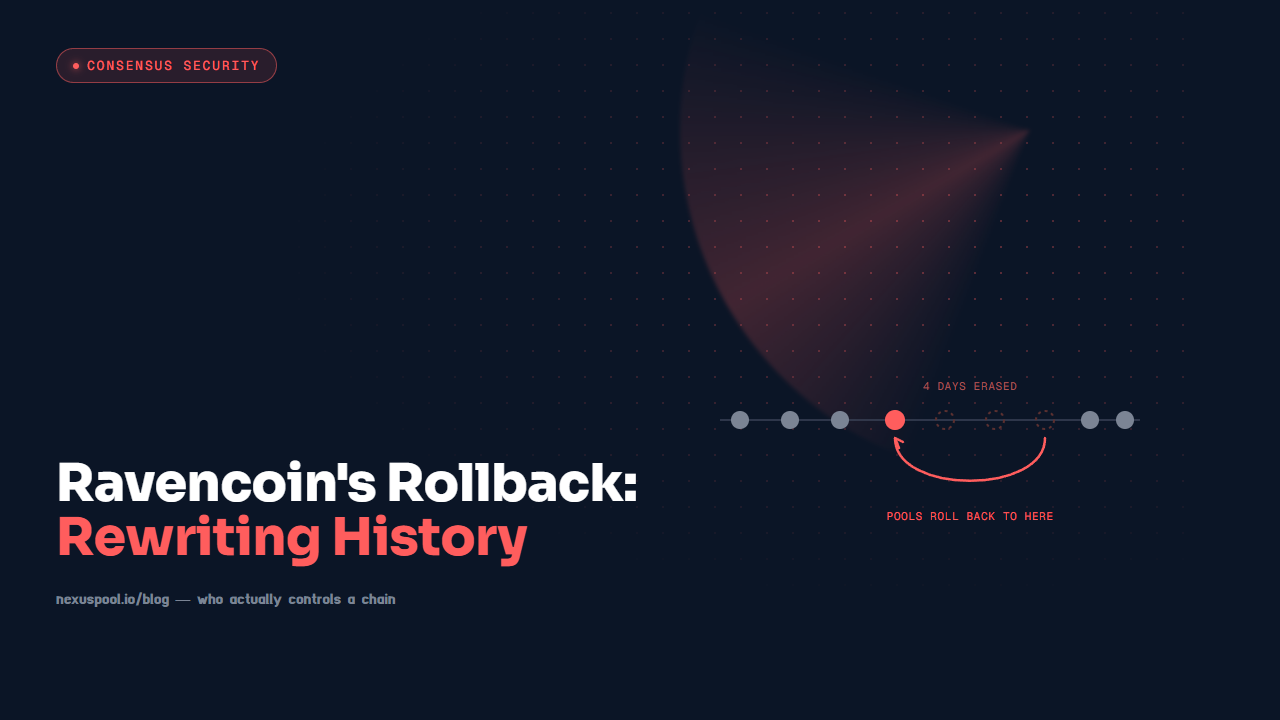
On August 7, 2026, a Ravencoin node accepted a block it should have rejected. The block sat at height 4,487,776, and it passed validation because of a gap in how Ravencoin's KAWPoW proof-of-work checks a field called nHeight, the value that is supposed to confirm a block actually belongs at the position in the chain where it claims to sit. That field was never being checked against the block's real position, and once someone noticed, they used the gap to submit blocks without doing the computational work KAWPoW exists to require in the first place. Four days of chain history followed on top of that opening. Then two mining pools, controlling most of Ravencoin's hashrate, decided on their own to mine a version of the chain that erases all of it. The Ravencoin mining pool rollback that followed raises a question a lot of people assumed had a settled answer.
Wait, Can a Mining Pool Actually Rewrite Blockchain History?
Not in the sense of editing old blocks directly. What a pool with majority hashrate can do is choose which chain to keep extending, and since the longest valid chain is what nodes follow, that choice functions as a rewrite in practice. In Ravencoin's case, two pools, 2Miners and RavenMiner, publicly stated they were mining a branch that excludes everything from block 4,487,776 onward, which puts four days of otherwise legitimate transactions back to zero. Coins move back to where they started. Anyone who received a payment, made a trade, or confirmed a transfer during that window watches it get undone, through no fault of their own.
What Actually Broke Inside Ravencoin's Code?
The nHeight field exists specifically so a block cannot claim to be something it is not. Skipping that check meant an attacker could produce blocks that looked structurally valid without actually performing the hashing work KAWPoW is designed to demand, which is the entire security assumption a proof-of-work chain rests on. Ravencoin's own project account confirmed the vulnerability had been demonstrated and exploited, and confirmed the first known invalid block's height and timestamp. A patch followed, and independent reporting on the rollback decision lays out how the four days of blocks produced before the patch did not simply disappear on their own; someone had to decide what to do about them.
Why Did Two Pools Get to Make This Ravencoin Mining Pool Rollback Call Alone?
Because between them, 2Miners and RavenMiner control most of Ravencoin's network hashrate, which means their combined choice of which chain to mine is, functionally, the chain that wins. Reporting on the incident notes that the Ravencoin project asked the pools to restart the rollback from a later point, which would have put less transaction history at risk, and that the pools declined. That is not a governance vote or a community signal. It is two operators deciding, and the rest of the network following because that is how proof-of-work resolves competing chains. Several exchanges have already halted RVN deposits and withdrawals while this settles, and RVN's price dropped sharply on the news.
Does Any of This Reach Bitcoin, Litecoin, Dogecoin, or Bitcoin Cash?
Not through this specific bug. The nHeight validation gap is Ravencoin-specific code, not something shared with Bitcoin's codebase or its Scrypt-based relatives, and NexusPool does not support solo mining on Ravencoin at all. What does reach every proof-of-work chain, including the ones NexusPool does support, is the underlying dynamic: whoever controls enough hashrate controls which chain gets extended, and that is true on any chain, not a defect unique to Ravencoin. It is also exactly why non-custodial design and independent verification matter regardless of which chain someone mines. A pool that never holds a miner's balance in the first place cannot decide what happens to it after the fact, and a signed, checkable record of what a pool actually did is worth more than a promise about what it will do. That is the entire premise behind NexusPool's own signed work receipts, called Glass Ledger, and behind publishing how its Stratum V1 and Stratum V2 connections actually work rather than asking a miner to take that on faith.
What Should This Actually Change About How You Trust a Mining Pool?
Nothing about the Ravencoin situation changes the math behind solo mining odds on any chain. Those odds are set by a miner's hashrate divided by the network's total hashrate, identical for every miner on a given chain, and no rollback, pool decision, or protocol bug changes that ratio. What the Ravencoin mining pool rollback does illustrate, plainly, is what majority hashrate concentrated in a couple of operators can actually do when a chain's integrity is on the line, and why checking a pool's own infrastructure directly is worth doing rather than assuming good behavior by default. NexusPool's current status is published for exactly that reason, so it can be checked rather than taken on trust.
This post does not claim Ravencoin's vulnerability affects Bitcoin, Litecoin, Dogecoin, or Bitcoin Cash, does not predict RVN's price, and is not investment guidance about RVN or any other asset. It also does not claim any pool, including NexusPool, is immune to every possible bug; it claims only that a non-custodial structure limits what a bug or a bad decision can do to a miner's actual holdings, since the pool never has custody of them to begin with.
So can a mining pool rewrite blockchain history. Yes, when enough hashrate agrees to, and Ravencoin just showed what that looks like in practice.
Trust nothing. Verify who actually controls the hashrate behind any chain you mine on, and what that control lets them decide.