Glass Ledger
Dogecoin Core 1.14.9: A Merge Miner's Update Night
A Dogecoin Core 1.14.9 notification interrupts a Friday night merge-mining check. What the update actually patches, and why Dogecoin inherits bugs.
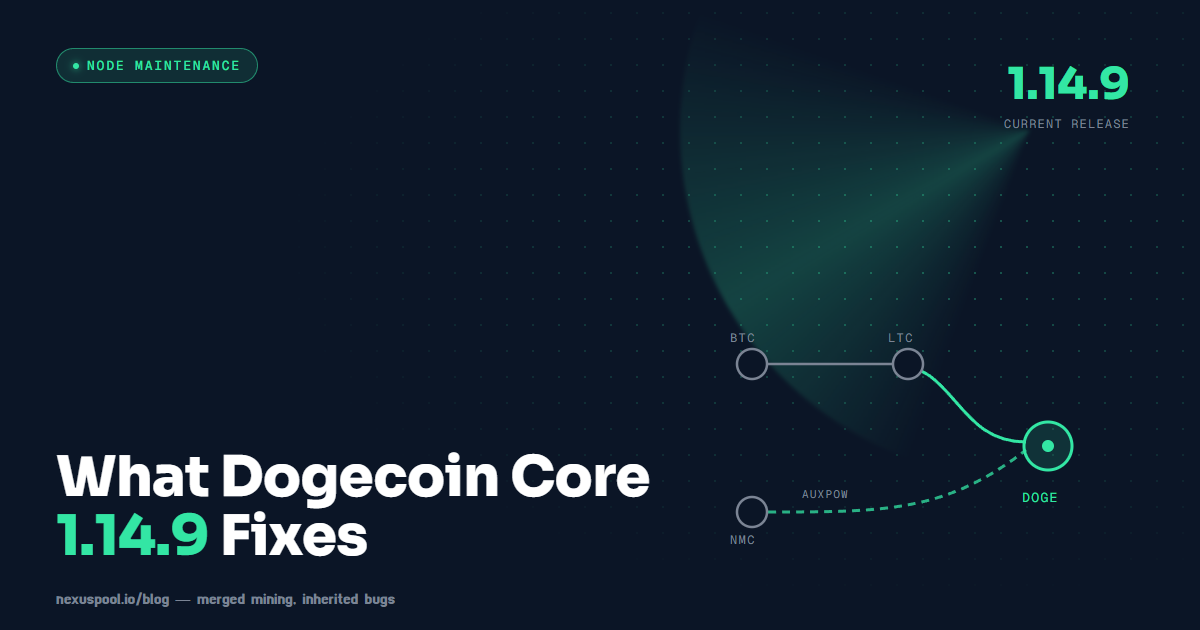
It is a Friday evening and the dashboard is open out of habit more than need: a home Scrypt rig, pointed at a solo pool, mining Litecoin with Dogecoin riding along for free through merged mining. Nothing unusual tonight, hashrate steady, no blocks found, nothing withdrawn because nothing is ever held anywhere to withdraw from. Then a notification lands from the GitHub repo watched months ago and half-forgotten: Dogecoin Core 1.14.9 is out, described as containing important bugfixes, upgrade strongly recommended for all users. The instinct is to snooze it. The honest question worth answering first is why a coin built around a Shiba Inu meme needs a security-driven update at all, and what "inherited bugfixes" even means for a chain that is not really its own codebase from scratch.
What Dogecoin Actually Inherits, and From Where
Dogecoin was forked from Litecoin in 2013, which was itself forked from Bitcoin, and it separately borrowed its merged-mining machinery, the AuxPoW format that lets a single proof of work secure both a Litecoin block and a Dogecoin block at once, from Namecoin, one of Bitcoin's earliest alternative-chain experiments. That lineage means Dogecoin Core is not an isolated project maintained in a vacuum. When a security-relevant bug turns up in Bitcoin Core or Namecoin Core, upstream code that Dogecoin's own codebase still shares in some form, it can surface in Dogecoin Core too, arriving as an inherited issue rather than something unique to Dogecoin's own development. Release 1.14.9 is exactly that kind of patch: a minor version bump that folds in fixes for security-relevant bugs upstream in Bitcoin Core and Namecoin Core that had made their way into Dogecoin's own tree over the years.
Why This Matters Specifically for a Merge Miner
Sitting at the dashboard, the part that actually matters for tonight's setup is the AuxPoW validation path. A merge-mining node has to correctly verify the auxiliary proof-of-work header linking a Litecoin block to a Dogecoin block, on top of everything else a full node validates. A bug inherited from either upstream codebase does not announce itself as "this only affects merge mining," but bugs in shared validation code have a way of touching exactly the paths that AuxPoW depends on, since that validation logic sits close to the core block and transaction checking that every fork inherits together. Running outdated node software is a different risk than running outdated miner firmware: it is not about hashrate or efficiency, it is about whether the software correctly enforces the rules it is supposed to enforce.
What Dogecoin Core 1.14.9 Actually Contains
Dogecoin Core 1.14.9 is described in its own release documentation as a new minor version containing important bugfixes, with upgrading strongly recommended for users on any platform. The fixes specifically address upstream bugs inherited from Bitcoin Core and Namecoin Core, the two codebases Dogecoin's history runs through. There is also a minor known issue noted for anyone compiling from source on FreeBSD 14.1, an endian-specific function error with a documented workaround, the kind of detail that only matters if you build your own node rather than running a packaged release.
Running the Upgrade on a NexusPool Merge-Mining Setup
The update itself is a normal node upgrade: stop the running dogecoind process, replace the binaries with the 1.14.9 release, restart, and let it resync from where it left off. Nothing about the upgrade requires touching wallet files, regenerating addresses, or changing anything about how a mining setup is configured. For anyone merge mining through NexusPool's technology page, the pool's own handling of Dogecoin's AuxPoW reward alongside a Litecoin solo attempt does not change with a node-side patch like this one; the update lives entirely on the validation side, not the payout side. A pool-side node still has to run correct software too, which is a separate reason full-node upgrades on any merge-mined chain are worth tracking even when nothing on the miner's own end looks broken.
Back at the Dashboard
The upgrade takes about four minutes, most of it spent waiting for the resync to catch back up to the tip. The dashboard looks exactly the same afterward: steady hashrate, no blocks found yet tonight, LTC and DOGE both still paid straight to a self-held address the moment either one is actually won, nothing sitting in a balance anywhere in between. What changed is not visible in the interface at all. It is that the node enforcing those rules is now running code with the known upstream issues patched, rather than code that still carried them. That is the entire value of a release like this one: not a new feature, not a performance gain, just one fewer gap between what the software is supposed to check and what it actually checks.
This post does not claim that any past version of Dogecoin Core was exploited in the wild, only that 1.14.9 patches inherited bugs its own release notes describe as security-relevant, and it is not investment advice about Dogecoin, Litecoin, or merged mining generally. Solo mining odds on either chain are set by difficulty relative to your own hashrate, identical for every miner, and no node upgrade changes that math. You can read more about how NexusPool structures its own merged mining and payout system on its site. For the release itself, Dogecoin's own repository carries the full technical detail; see the official Dogecoin Core 1.14.9 release on GitHub.
Trust nothing. Verify that the node validating your merge-mined blocks is actually running current software.