Glass Ledger
Litecoin's MWEB Patch: Do You Need It?
Litecoin Core v0.21.5.6 patches an urgent MWEB validation bug ahead of a soft fork deadline. Here is what solo miners actually need to check.
On August 4, 2026, the Litecoin developers pushed Litecoin Core v0.21.5.6, an urgent maintenance release that tightens validation around MWEB, Litecoin's optional privacy feature, ahead of a soft fork activation roughly a week later. If you run a Litecoin node, point a Scrypt rig at a pool, or just hold LTC in a wallet that touches MWEB, that timeline probably reached you as a vague "you should upgrade" notice without much explanation of why. Here is what the Litecoin Core MWEB upgrade actually changes, in the form of the questions a working miner or node operator would actually ask before touching their setup.
What Is MWEB, and Why Does It Need a Security Patch?
MWEB stands for Mimblewimble Extension Blocks, an opt-in feature that lets Litecoin users send and receive transactions with hidden amounts and addresses, layered on top of Litecoin's normal, fully transparent chain. Because MWEB transactions are verified differently than ordinary ones, involving more expensive cryptographic checks, they are also a more attractive place for someone to try to cause problems: flooding a node with expensive-to-verify requests, or crafting transactions that exploit an edge case in how MWEB blocks get built and checked. Release v0.21.5.6 closes several of those edges directly. It adds a node-wide limit on expensive MWEB light-client service requests, the kind of query a lightweight wallet makes to a full node, so a flood of them cannot exhaust a node's resources. It adds relay-policy limits on MWEB transaction weight and input count before a node commits to the expensive cryptographic verification work. And it makes block construction itself enforce the MWEB consensus input limit, so a miner cannot even assemble an oversized MWEB input set into a block in the first place.
Do I Actually Need the Litecoin Core MWEB Upgrade?
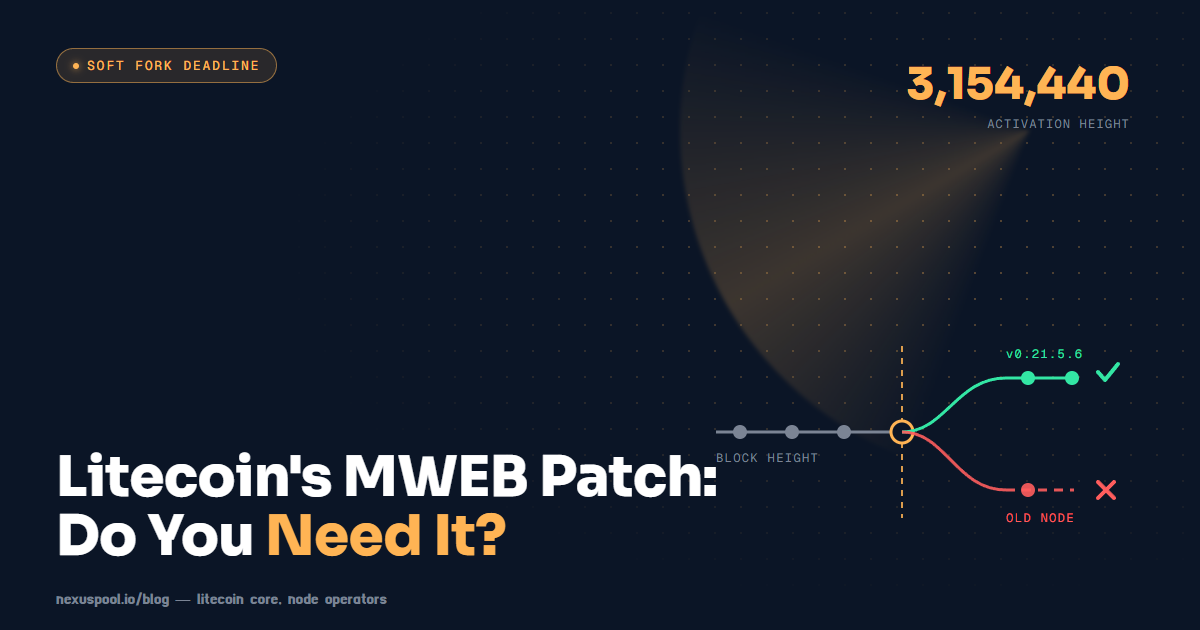
If you run your own Litecoin full node, yes, and on a real deadline. The release also ships a soft-forking consensus rule that activates at mainnet block height 3,154,440, about 4,032 blocks, or roughly one week, after height 3,150,408. Starting at that height, nodes running the patched software will reject an MWEB block whose kernel signals a pegout while carrying an empty pegout list, a specific malformed-block pattern the update is designed to catch. A node still running the old version does not enforce that rule and will not protect you from it.
What Happens If I Don't Upgrade Before the Deadline?
For an ordinary wallet user, the practical risk is mostly about safety margins rather than an immediate loss: staying on old software leaves the validation gaps open that this release closes. For anyone building blocks, meaning a mining pool or a solo miner running their own node and template, the stakes are sharper. Once the soft fork activates, a block that violates the new consensus rule will be accepted by old nodes but rejected by every upgraded node on the network, the classic recipe for an accidental fork and a wasted block. Litecoin's own developers framed the guidance plainly: miners, pools, and anyone running MWEB services should upgrade before the activation height, not after.
Does This Change My Solo Mining Odds on Litecoin?
No, and it is worth separating the two questions cleanly. This patch changes how nodes validate MWEB transactions and blocks. It does not touch the difficulty calculation, and it does not touch the coinbase transaction that pays out a found block. Your odds of finding a Litecoin block solo are set by your own hashrate relative to the network's total hashrate at the time, identical for every miner pointed at the chain, and nothing about a validation patch changes that arithmetic. What the patch does affect is whether a block you or your pool build gets accepted by the rest of the upgraded network, which is a real, practical thing worth getting right regardless of your odds on any given day.
Is This a One-Off, or Part of a Pattern?
Worth knowing before you shrug this off as routine: this was reported as the fifth Litecoin Core patch in roughly two months, following an earlier MWEB-related incident this spring. That cadence suggests MWEB's cryptographic surface has needed more active maintenance than a typical, already-stable part of the protocol, which is a reasonable thing to watch if you rely on MWEB specifically, separate from whether you use Litecoin's transparent chain at all.
Where This Leaves a NexusPool Solo Miner
NexusPool's own payout design does not depend on MWEB in any way: solo mining on NexusPool's Litecoin page pays a found block's reward straight to your own address in the same coinbase transaction that creates it, with 0% pool fee, the same as it does on Bitcoin, Dogecoin, and Bitcoin Cash. That part of the picture does not change with this patch. What is worth checking on your own end is simpler: if you run your own Litecoin node alongside your mining setup, confirm it is on v0.21.5.6 or later before the activation window passes, and if you use MWEB for any transactions, do the same for your wallet software. You can read more about how NexusPool's protocol and payout handling fits together on its Litecoin technology page.
This post is not investment advice and does not claim that upgrading, or not upgrading, changes your solo mining odds, which are set purely by difficulty relative to your own hashrate. It also is not a claim that NexusPool's own software is open source; it is not. For the underlying technical changes in this release, Litecoin's own release notes lay out every rule change in detail; see the official Litecoin Core v0.21.5.6 release notes on GitHub.
The single biggest question here, answered directly: if you run a Litecoin node or a wallet that touches MWEB, update to v0.21.5.6 or later before the soft fork activation window, because after that point old and new nodes will disagree about which blocks are valid.
Trust nothing. Verify which Litecoin Core version your own node is actually running.