Dogecoin
Dogecoin Block Reward Cut: Myth vs Reality
A GitHub discussion would cut Dogecoin's block reward 90%. Here is what that would do to the Litecoin merged mining behind it, myth by myth, with the numbers.
A community proposal in the dogecoin/dogecoin GitHub repository would cut Dogecoin's block reward from 10,000 DOGE per block to 1,000, a 90% drop in new issuance. The discussion opened in January 2025, has drawn 21 comments and replies (the latest on August 26) and carries no activation plan. A Dogecoin Core maintainer replied within days that economic changes this late in the project's life break the deal the protocol made with its users, and that the idea is unlikely to pass unless there is no other way. Price-prediction sites revived it on September 28. The pitch sounds simple: less new supply, more scarcity. Most of the coverage skips what a Dogecoin block reward cut would do to the machines that secure the chain. Dogecoin has been merge-mined with Litecoin since 2014, so a Scrypt miner can produce a valid Litecoin block and a valid Dogecoin block from the same work at the same moment. A change aimed at issuance also changes the pay behind that shared hashrate.
Myth: a Dogecoin block reward cut is a simple scarcity win
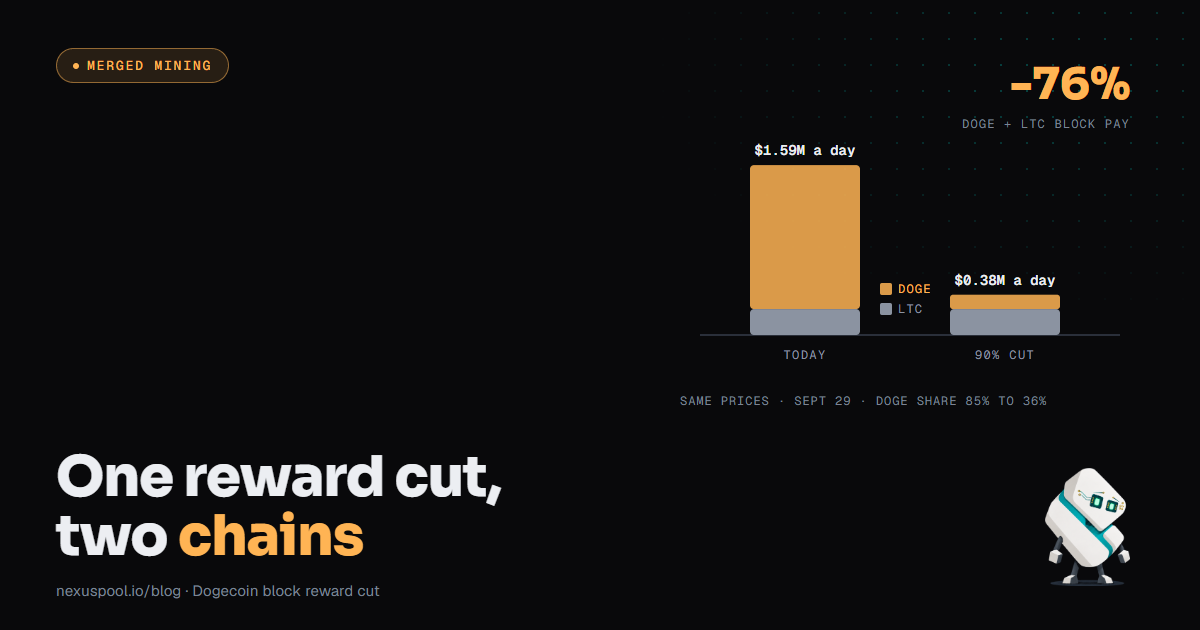
The pitch treats the reward like a Bitcoin halving, where fewer new coins should mean more value per coin. For the machines securing Dogecoin, the reward is also a paycheck, and the larger of two. A Litecoin miner pointed at a merge-mining pool collects DOGE at no extra electricity cost, because AuxPoW lets one proof of work satisfy both chains' difficulty targets. At Coinbase spot prices on September 29 (DOGE $0.0939, LTC $67.57), Dogecoin's scheduled 14.4 million DOGE a day is worth about $1.35 million, against about $243,000 for Litecoin's 3,600 LTC. Dogecoin supplies about 85% of the block subsidy that merge-mining Scrypt hardware earns. Cut the DOGE reward by 90% and that combined pay drops about 76% at unchanged prices. The proposal expects a higher DOGE price to cover the gap. That is a hope, and nothing in the protocol delivers it.
Myth: this is already a Dogecoin halving in motion
A Bitcoin halving is a consensus rule with a fixed block height, written into the software from the start. This proposal is one community member's GitHub discussion. It has no activation height, no timeline and no promise of adoption. Turning it into a rule would take Dogecoin's core developers, a new release of the reference client, and enough hashpower to enforce it. A lower reward is a stricter rule, so blocks that keep claiming 10,000 DOGE would be invalid to upgraded nodes, and the miners and pools who would have to switch are the ones whose income it cuts. Coverage that calls this an imminent halving describes where the debate could end up, not where it stands.
Myth: a Dogecoin reward cut leaves Litecoin alone
Litecoin's rules would not change, and its reward would stay at 6.25 LTC. Its security still comes from machines, and those machines mine one hash and collect two rewards. When the combined pay falls, the miner on older hardware or pricier power decides whether the shared work still pays, and a machine that switches off leaves both chains at once. Dogecoin's difficulty implies about 3.1 PH/s and Litecoin's about 2.6 PH/s, so the same machines could supply most of Dogecoin's hashrate. Litecoin.watch argued in June that Litecoin's security depends on Dogecoin's revenue rather than Dogecoin's hashpower. Dogecoin Foundation director Timothy Stebbing said in July that most merged-mined Scrypt coins depend on Dogecoin issuance for their mining economics. Litecoin's own reward halves to 3.125 LTC in 2027, which tilts the split further toward Dogecoin.
The Dogecoin block reward cut in numbers
| Today (10,000 DOGE/block) | Proposed (1,000 DOGE/block) | |
|---|---|---|
| Block reward | 10,000 DOGE | 1,000 DOGE |
| New DOGE issued per year (1 block a minute) | 5.256 billion | 525.6 million |
| Share of the 156.1 billion DOGE in circulation | about 3.4% a year | about 0.34% a year |
| Dogecoin block rewards per day, at $0.0939 | about $1.35 million | about $135,000 |
| Litecoin block rewards per day, at $67.57 (unchanged) | about $243,000 | about $243,000 |
| Dogecoin's share of the two rewards combined | about 85% | about 36% |
| Rule status | Live consensus rule | Community discussion, no activation height |
The issuance math is plain multiplication: 10,000 DOGE times 525,600 one-minute blocks in a year is 5.256 billion DOGE, and 1,000 DOGE gives 525.6 million. Against the 156.1 billion DOGE in circulation on September 29 (Blockchair), that is about 3.4% a year now and 0.34% after the cut. The pay rows use scheduled block times, 1,440 Dogecoin blocks and 576 Litecoin blocks a day, leave out transaction fees, and change as either price moves, so read them as a snapshot and not a forecast.
Difficulty sets the odds of finding either chain's next block, the same at every pool, NexusPool included, and no proposal changes that. This is a governance and incentive story, and nothing in it predicts the price of DOGE or LTC.
The reality, in short
A 90% cut to the Dogecoin block reward is a real proposal with a real mechanism behind the worry. At today's prices it would remove about three-quarters of the block pay that merge-mining Scrypt hardware earns, and the hashrate that switches off would leave Litecoin too. It is a 20-month-old discussion from one community member, with no activation height and a maintainer's reply that it is unlikely to pass. Miners on NexusPool's Litecoin and Dogecoin merged mining do not need to do anything today. A block a rig finds through NexusPool's Litecoin support pays the Litecoin and Dogecoin addresses you supply at a 0% pool fee, and an hourly Glass Ledger receipt records the shares the pool counted for each rig. Trust nothing. Verify what a reward-cut proposal would do to the pay behind the hashrate.