Solo Bitcoin Mining
How to Recalculate Your Solo Mining Odds as Miners Chase AI
Big miners are shifting hashrate to AI data centers. Here is the exact step-by-step math to recalculate your own solo mining odds as network hashrate moves.
Several of the largest publicly listed Bitcoin mining companies have spent 2026 redirecting capital and data center capacity toward AI and high-performance computing work instead of expanding their own mining fleets. CoinDesk's reporting on the trend noted that Bitcoin's network hashrate posted its first first-quarter drop in six years in early 2026, hovering around 1 zettahash per second and down roughly 4% year to date at that point, as mining margins tightened and AI infrastructure contracts offered steadier returns. That is a real shift in who is competing for blocks. Here is exactly how to work out what it means for your own solo mining odds, using your own numbers, not a headline.
Step 1: Understand Why This Number Is Moving at All
Network hashrate is the sum of every miner's hashrate pointed at a chain at a given moment. When large operators pull hashrate away, whether toward AI infrastructure, a different chain, or simply offline, the total falls, at least until other miners bring new capacity online to fill the gap. That single number, total network hashrate, is the denominator in every solo mining odds calculation there is. Nothing else about your own setup needs to change for your odds to shift when it moves.
Step 2: Find the Current Network Hashrate for Your Chain
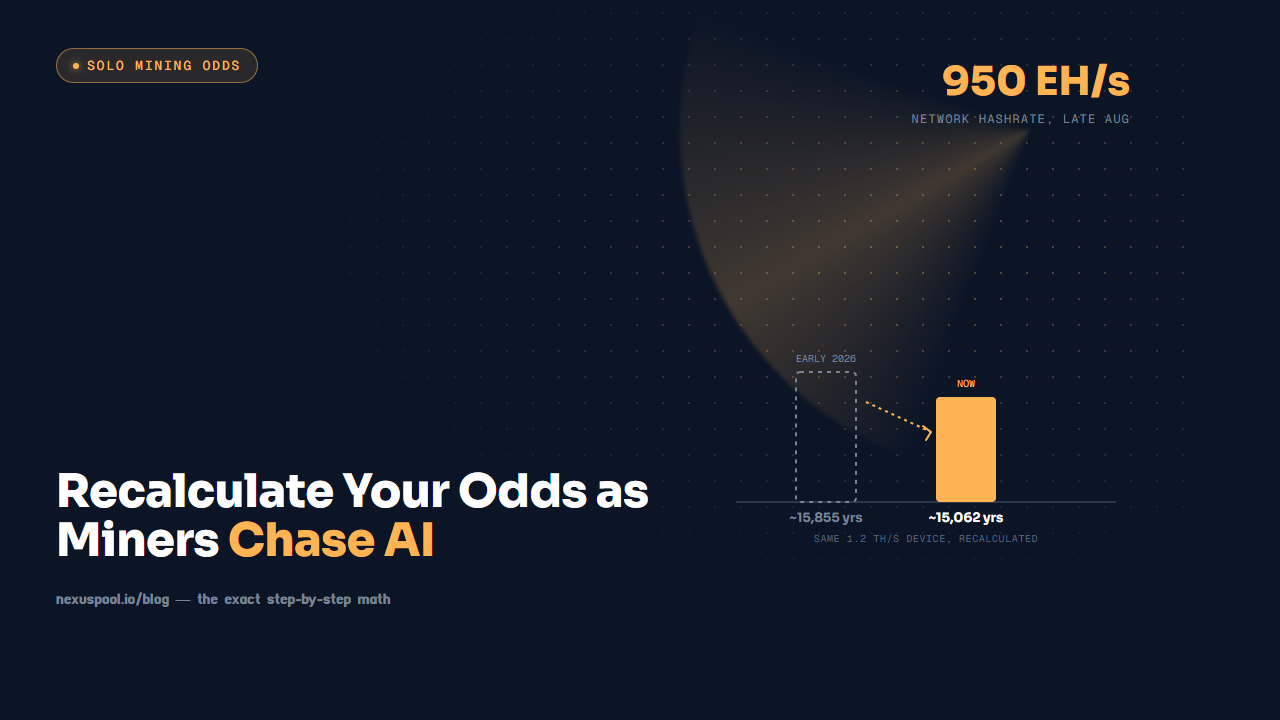
Before doing any math, look up a live figure yourself from a hashrate tracker rather than trusting a number in an article, since this figure changes constantly and any specific value here is already dated by the time you read it. For this walkthrough, we will use an illustrative figure of 950,000,000 TH/s (roughly 950 EH/s), in line with where public trackers were putting Bitcoin's network hashrate in late August 2026 as the AI-pivot trend CoinDesk described continued through the year.
Step 3: Find Your Own Device's Hashrate
Check your rig's actual reported hashrate, not its spec-sheet maximum, ideally averaged over several hours to smooth out normal variance. For this walkthrough, we will use 1.2 TH/s, a realistic figure for a single open-hardware solo device.
Step 4: Divide to Get Your Per-Block Probability
The formula is your hashrate divided by the network's total hashrate. Using the two figures above: 1.2 divided by 950,000,000 equals approximately 1.26 x 10^-9, or about a 1-in-792-million chance of finding any single block.
Step 5: Convert Your Solo Mining Odds Into an Expected Wait in Years
Take the reciprocal of your per-block probability, 950,000,000 divided by 1.2, which gives roughly 791,666,667 blocks. Divide that by the approximate number of Bitcoin blocks mined per year, about 52,560 at a 10-minute average interval, and the expected wait comes out to roughly 15,062 years. Run the same formula against last year's higher hashrate, using 1,000,000,000 TH/s (roughly 1 zettahash per second, the level CoinDesk described the network hovering near in early 2026) against the same 1.2 TH/s device: 1,000,000,000 divided by 1.2 is about 833,333,333 blocks, divided by 52,560 comes out to roughly 15,855 years. The difference, about 793 fewer years of expected wait at the lower hashrate figure, is entirely a function of the denominator shrinking by roughly 5%. It is not a result of anything a pool did, and it moves the other way just as easily if hashrate climbs back up, which it has done repeatedly through 2026.
Step 6: Verify Nothing Else Changed in Your Setup
A shrinking denominator does not mean your own configuration is still correct. Before treating any recalculated number as meaningful, confirm your rig is actually pointed at the pool and payout address you intend, since a solo mining setup with a misconfigured address is a real risk regardless of what the network hashrate happens to be doing that week. NexusPool's Payout Preflight tool reconstructs and checks a coinbase transaction against your configuration before a block is ever found, which is the moment to catch a typo, not after a lucky strike. NexusPool's own protocol documentation covers how its native Stratum V1 and Stratum V2 support, with same-port auto-detection, handles the connection itself regardless of which chain or hashrate conditions you're mining under.
What This Math Does and Does Not Tell You
This walkthrough shows how to compute your own numbers, not a promise about what they will be next month. Hashrate is volatile in both directions, AI infrastructure demand and mining profitability both shift for reasons that have nothing to do with any individual miner, and a lower expected wait is still an average over an extremely random process, not a schedule. Some solo miners find a block far sooner than any of these figures suggest, and most who run the numbers above will not find one in the stated expected wait at all. None of this is investment advice, and nothing here changes the underlying fact that odds are set by hashrate alone, identical for every miner on a chain no matter which pool relays their shares.
Recap: The Six Steps
- Understand that network hashrate is the denominator behind your odds.
- Look up the current network hashrate from a live tracker.
- Check your own device's actual reported hashrate.
- Divide your hashrate by network hashrate for your per-block probability.
- Take the reciprocal and divide by roughly 52,560 blocks per year for an expected wait.
- Verify your pool and payout configuration before treating any of it as real.
Trust nothing. Verify the hashrate numbers before you trust anyone's odds claim, including your own math from last month.