Glass Ledger
Solo Bitcoin Cash Mining in 2026: A Reader Self-Check
Bitcoin Cash is drawing fresh attention after a price surge and a self-custodial payments launch. Here is an honest self-check before pointing hardware at it.
Bitcoin Cash has been getting attention for two unrelated reasons at once this August. A self-custodial card payment system built on BCH smart contracts, using NFC tap authentication to set on-chain spending limits, launched at the Cash 3.0 Conference in early August, and BCH's price moved sharply over the following weeks on broader market conditions. Neither event has anything to do with mining difficulty or network hashrate, but both tend to send solo Bitcoin Cash mining 2026 search interest up regardless, because a coin getting attention is exactly when people start wondering whether it is worth pointing spare hardware at. This self-check walks through what that decision should actually rest on.
Check Yourself Against These Questions
- Are you interested in BCH specifically because of the price move or the payments launch, rather than because you already understand what solo mining involves?
- Do you already own SHA-256 ASIC hardware, such as a Bitaxe-class board, that could point at BCH without a new purchase?
- Do you understand that BCH uses the same SHA-256 mining algorithm as Bitcoin, so any SHA-256 device can technically mine either chain?
- Have you looked at BCH's actual current network hashrate rather than assuming it behaves like Bitcoin's?
- Are you prepared for an expected wait measured in years, not days, even on a smaller network?
- Have you confirmed that any pool you would use actually pays the block reward straight to your own address, rather than holding a balance?
If most of these are unchecked, the honest answer is to keep reading before doing anything else. If most of these are checked, the numbers below are what actually determine whether it makes sense for your specific hardware.
Why a Smaller Network Does Not Mean Easy Solo Bitcoin Cash Mining 2026 Odds
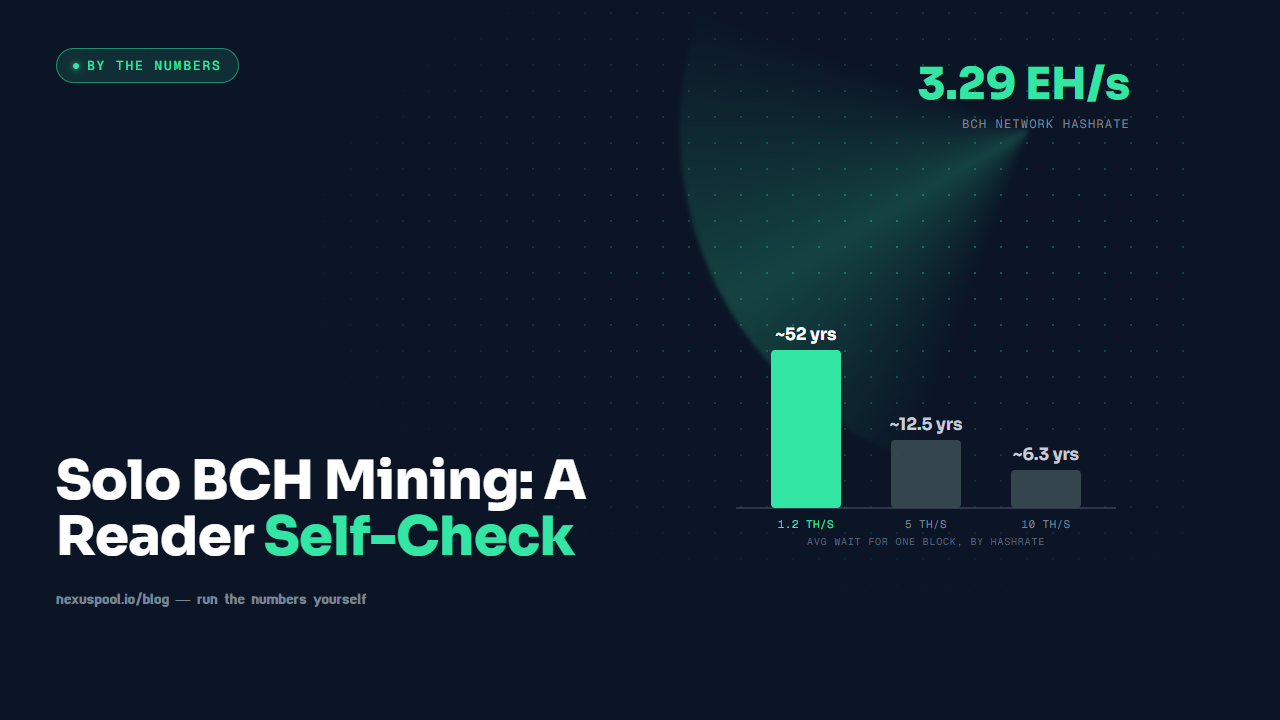
BCH's network hashrate has been reported at roughly 3.29 EH/s as of August 24, 2026, dramatically smaller than Bitcoin's roughly 920 to 1,000 EH/s. That size difference is real, and it does mean a given amount of hashrate represents a larger share of the BCH network than the same hashrate would on Bitcoin. It does not mean the odds are good in any absolute sense, because the math is still a straight ratio of your hashrate against the whole network's, with no shortcut around it.
Take a single Bitaxe-class device running at 1.2 TH/s, a real, current, and inexpensive piece of hardware. Divide 1.2 TH/s by BCH's 3.29 EH/s (3.29 million TH/s) and the result is a per-block probability of about 0.0000365%, or roughly 1 in 2,741,667. Divide that block count by approximately 52,560 blocks per year, the same 10-minute-average block cadence Bitcoin targets, and the expected wait for that single device works out to roughly 52 years on average. That is the two inputs, 1.2 TH/s against 3.29 EH/s, run through the same math every time, and it does not change because a headline about a new payments product or a price move made the coin more visible this month.
Try the Numbers Yourself
The table below runs the same calculation across a few realistic home setups. All figures use BCH's approximate 3.29 EH/s network hashrate as of August 24, 2026, and 52,560 blocks per year.
| Home hashrate | Share of BCH network | Expected average wait for one block |
|---|---|---|
| 1.2 TH/s (one Bitaxe-class board) | ~0.0000365% | ~52 years |
| 5 TH/s (a small home cluster) | ~0.000152% | ~12.5 years |
| 10 TH/s (a larger home cluster) | ~0.000304% | ~6.3 years |
For anyone who wants to plug in their own hardware's hashrate instead of one of the three examples above, the small calculator below runs the identical formula, hashrate divided by network hashrate, then converted into an expected wait using the same 52,560 blocks-per-year figure. It is meant for Ghost's native HTML card, the /html card type in the post editor, not the regular text card, and it makes no network calls of its own.
Uses BCH network hashrate of 3.29 EH/s (Aug 24, 2026) and 52,560 blocks per year. An estimate only, not a promise of any outcome.
What the Attention Around BCH Does Not Change
A self-custodial payments launch and a price move are both real events, but neither one touches network hashrate, and network hashrate is the only variable that sets solo mining odds on any chain. A coin becoming more visible does not make it easier to find a block on, and nothing here should be read as a signal about where BCH's price is headed next.
If You Decide to Join
If your checklist above came back mostly checked, that is, you already own SHA-256 hardware, you understand the wait is measured in years, and you have confirmed a non-custodial pool pays out directly, then pointing an existing device at BCH costs you nothing beyond electricity and is a reasonable way to participate in a lottery you already understand. NexusPool supports solo mining on Bitcoin Cash alongside Bitcoin, Litecoin, and Dogecoin through its own technology stack, with the same 0% fee and direct-to-your-address payout on every chain it supports. If your checklist came back mostly unchecked, the better move is to spend time understanding the odds math first, and an overview of how NexusPool itself is set up is a reasonable starting point for that, rather than pointing hardware at a chain because it is in the news this week.
This post does not claim BCH is a better or worse solo mining target than any other chain in absolute terms, does not predict BCH's price, and does not promise any return on hardware or electricity spent mining it. Solo mining odds are set entirely by hashrate against network difficulty and nothing about a price move or a new payments feature changes that. Current BCH network hashrate figures used above come from minerstat's public network data, which is worth checking directly before relying on any single article's numbers, including this one.
Trust nothing. Verify BCH's actual current network hashrate yourself before pointing any hardware at it.