Glass Ledger
Inside a $244,900 Solo Bitcoin Win
A solo miner just took home 3.147 BTC on Braiins Solo after a 40-day drought. Here is what the odds actually were, and what changes once you win.
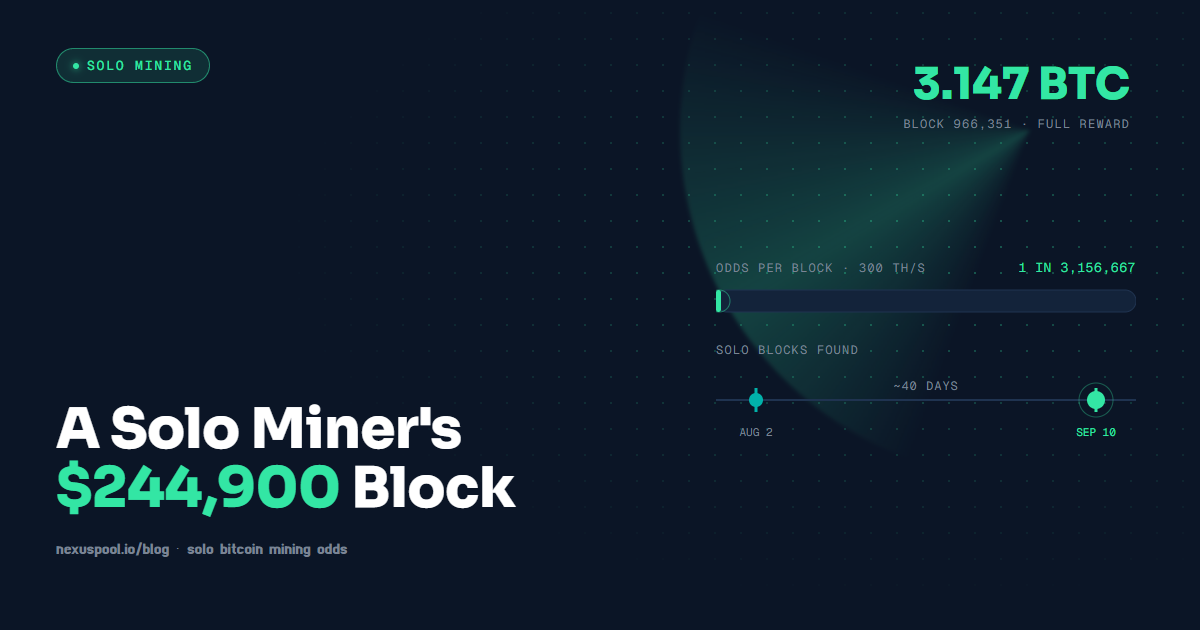
On September 10, 2026, a small miner's dashboard did something it had not done in weeks. A submitted share stopped being just another number in a hashrate graph and turned into a full Bitcoin block. Block height 966,351 confirmed on the network, and the entire subsidy and fee total attached to it, 3.147 BTC, worth about $244,900 at the time, became the property of whoever's hardware had just found it. The miner filed no support ticket and waited on no withdrawal queue, and no pool operator decided when the money moved. The coinbase transaction paid the miner's own address inside the block itself, which is how every coinbase transaction works.
The service behind the win was Braiins Solo, one of a small handful of solo mining services that let individual miners point their own hashrate at the network and keep the entire reward if they are the one who finds a block. Braiins CEO Eli Nagar posted on X shortly after: "Somewhere, someone's having a very good day. Congratulations to the miner who just found block 966351 on Braiins Solo." According to reporting from Bitcoin.com, it was the first solo block anyone on the network had found in nearly 40 days, which tells you how rare these wins are, even on services built around chasing them.
The Real Solo Bitcoin Mining Odds Behind the Win
Any honest talk about solo bitcoin mining odds lands on the same numbers, and no pool, protocol, or piece of hardware moves them. The only two inputs that matter are the miner's own hashrate and the network's total hashrate, and the ratio between them is fixed for everyone mining the same chain at the same moment.
Take a single modern ASIC running at 300 TH/s, a reasonable stand-in for a serious home or small-operator rig, against a Bitcoin network hashrate of roughly 947 EH/s (947,000,000 TH/s), mempool.space's one-week estimate on September 12. Divide 947,000,000 by 300 and the odds of that specific miner finding any single block come out to about 1 in 3,156,667. Spread that across a year of blocks, roughly 52,560 of them at Bitcoin's 10-minute average spacing, and the same miner should expect to wait around 60 years for a win, on average. Bitcoin.com's reporting did not disclose the hashrate behind the block 966,351 winner, so that 300 TH/s figure is an illustration of the math, not a claim about this specific miner's rig. Smaller devices, like the open-hardware boards many home miners actually run at around 1 TH/s, push that expected wait into the tens of thousands of years.
Solo mining still has a point. The reward lands at random and lands full-sized, and no pool fee, firmware build, or marketing claim can shift the probability. Your hashrate measured against the network's decides it for every miner on the chain.
Two Solo Bitcoin Mining Wins, 40 Days Apart
The block before it deserves a look too. The last confirmed solo win prior to block 966,351 landed on August 2 at block 960,804, a 3.1569 BTC reward, and it came through a different service entirely: Solo CKPool. Two unrelated solo mining operations produced the network's last two long-shot winners, roughly 40 days apart, on different infrastructure, and no report connects the two miners.
Two venues paying out in a row says more about solo mining as a category than one service getting lucky twice. It also shows how far a solo service sits from a normal mining pool. According to Bitcoin.com's snapshot of mempool.space data, five large pools (Foundry, Antpool, F2Pool, ViaBTC and Spiderpool) found 78.31% of recent blocks. In a standard pool, hundreds or thousands of participants combine hashrate and split a share of every block the pool finds, smoothing out variance into small, frequent payments. In a solo service, each participant's own hashrate is tracked against the network on its own, and the entire block goes to whoever happens to find it. You trade steadiness for variance, and Braiins Solo and Solo CKPool share that trade with any solo setup, NexusPool's included, because the protocol sets the math and the service only runs it.
Why a Solo Payout Never Touches a Pool's Balance Sheet
After the block confirmed, the miner skipped the custodial step entirely. The winning miner did not need to trust an operator to eventually release funds, because a solo block's coinbase transaction pays the finder's address directly, on-chain, as part of the block itself. That is the same non-custodial design NexusPool builds its own solo mining support around for Bitcoin, Litecoin, Dogecoin through merged mining, and Bitcoin Cash: 0% pool fee, and the full block reward routed straight to the miner's own address rather than sitting in a pool-held balance waiting on a withdrawal.
NexusPool built Payout Preflight around that same fact. Payout Preflight reconstructs and checks a coinbase transaction byte for byte before a block is even found, so a miner can verify in advance that a win pays the address it is supposed to pay, rather than finding out after the fact. The same idea runs through Glass Ledger, which lets a miner check the pool's claims against evidence instead of taking them on faith. Readers who want the technical detail on how NexusPool handles Stratum V1 and Stratum V2 connections, including the same-port protocol auto-detection that lets older and newer mining firmware connect without extra configuration, can find that on NexusPool's technology page.
What Doesn't Change: The Math Is Still the Math
Don't read this as a reason to expect a payday. Solo mining is a real lottery, and the odds above apply equally to every miner pointing hashrate at Bitcoin, regardless of which service, pool, or piece of hardware they use. There is no version of solo mining, on NexusPool or anywhere else, that improves those odds, and nothing here should be read as investment advice or a promise of return. The block 966,351 winner had the same probability as everyone else. The dice landed, and the protocol paid out as designed, with no intermediary between the winning share and the winner's wallet.
Back at that dashboard, the miner stopped looking at percentages and projections and started looking at a settled on-chain balance they already controlled, before anyone had to ask for it. Solo mining offers that and costs that: a long wait, odds that move for nobody, and a block that belongs to its finder in full the moment it confirms.
Trust nothing. Verify that your own coinbase transaction pays your own address, every single time a block is found.