Bitcoin Mining
Why Payouts Miss Fees in Bitcoin Mining Pools
Why payouts miss fees in Bitcoin mining: trace coinbase outputs, fee policies, template selection, maturity, and direct on-chain payment to your address.
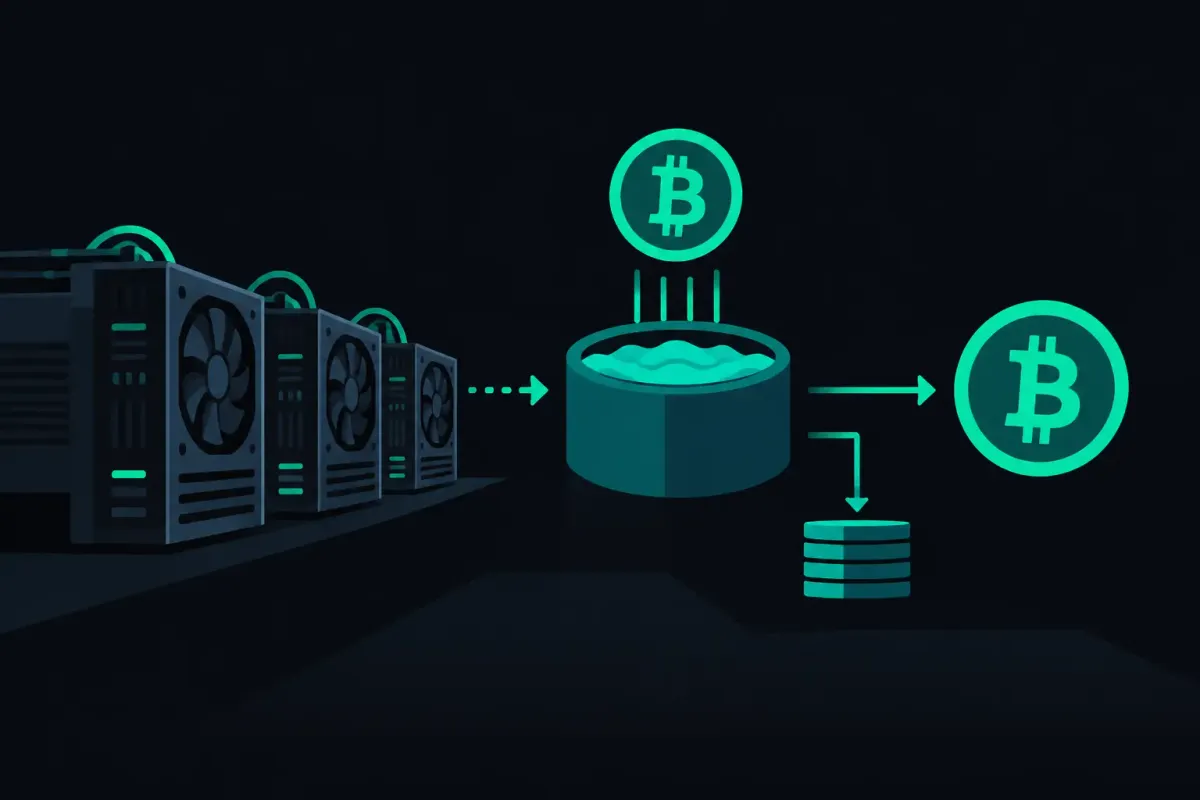
A solved block can show a 3.125 BTC subsidy, a visible fee total, and a payout that is smaller than their sum. That gap is why payouts miss fees for many miners. The answer is not always theft. It can be a stated pool fee, a payout rule, a block-template decision, a reporting mismatch, or simple confusion about what the chain proves.
The useful question is not whether a dashboard says you earned fees. It is where the fees went in the block's coinbase transaction, and whether that destination matches the arrangement you agreed to.
A block reward has two parts
Bitcoin pays the miner of a valid block through the coinbase transaction. The maximum coinbase value is the block subsidy plus the fees from transactions included in that specific block.
At the current subsidy era, 3.125 BTC is created by protocol rules. Transaction fees are not created. They are the difference between the inputs and outputs of each included transaction. Add those differences across the block, and that is the fee amount available to the coinbase transaction.
This distinction matters because a pool can advertise a low fee while still handling the two parts differently. It might take a percentage of the total block reward. It might charge only against the subsidy. It might retain transaction fees under a stated policy. It might pay miners based on shares and settle later from a pool-controlled wallet. Those are different economic arrangements, even if the worker interface looks identical.
A claimed reward is not the same thing as an on-chain output. The block itself is the settlement record.
Why payouts miss fees: the common causes
The first cause is direct and legitimate if it was disclosed: the pool's fee policy. If a pool charges a commission, the amount paid to a miner will be lower than the block's gross reward. A 1% fee calculated against subsidy plus transaction fees is different from 1% calculated against subsidy alone. Read the basis, not just the percentage.
The second cause is that the pool pays from its own accounting system rather than from the winning block's coinbase transaction. In a shared pool, this is normal architecture. The pool receives the block reward, measures contributed shares, applies its payout method, and sends balances later. Fees may be included, excluded, averaged, delayed, or netted against withdrawal charges according to its rules.
That model can produce frequent payouts, but it requires trust in several private calculations. You need to trust the share accounting, the balance ledger, the fee calculation, and the wallet that eventually sends the payment. A dashboard can explain the rules. It cannot independently prove that its internal ledger was complete.
The third cause is timing. A coinbase output cannot be spent until it has 100 confirmations. A block may be found, shown in a block explorer, and still be immature. A payout system may also wait for its own threshold or batch payments. That is a delay, not necessarily a missing fee. But a mature direct coinbase output is much easier to inspect than a future promise in an account balance.
The fourth cause is a mismatch between a fee estimate and the fees actually available in the submitted block. Mempool sites estimate conditions from transactions they see. Your pool's node builds one candidate template at a particular moment. The block you solve pays only the fees from transactions in that final template. It does not pay the highest fee total someone saw five minutes earlier.
Template selection has trade-offs. A pool may prioritize fee rate, transaction validation policy, propagation speed, or its own operational constraints. No pool can add transaction fees after a block is found. The coinbase transaction and the transaction set are committed by the block. If the template contains fewer fees, the maximum permitted coinbase amount is lower.
Finally, a miner may be comparing the wrong number. Some explorer pages display total fees, some show coinbase value, and some separate subsidy from fees. A transaction's fee is not always obvious from its outputs. Verify the block-level totals and the coinbase outputs before drawing a conclusion.
The coinbase transaction is the audit point
If you solve a block, start with its block height and hash. Open the block data and locate transaction zero. That is the coinbase transaction.
Check its total outputs. The total must not exceed the subsidy for that height plus the fees of all non-coinbase transactions in the block. Then inspect each output address and amount. A direct-payment setup should create an output to the Bitcoin address you supplied for that worker or account.
There can be more than one output for valid technical reasons. A coinbase may include an output for a mining payout, an output for a required protocol or operational destination, or an output split by the payment design. The presence of multiple outputs is not proof of a problem. What matters is whether each output is explained before you point hash rate at the pool.
This is also where labels stop mattering. A dashboard can call something a fee credit or reward adjustment. The chain only records sats and spending conditions. If the transaction sends the full permitted reward to your address, there is no pool-side balance to calculate or withdrawal to approve. If it sends the reward elsewhere, you need to understand the terms under which you are being credited.
Template control affects what can be proven
Mining is not only a payment problem. It is a work-construction problem.
With conventional Stratum V1, a pool generally distributes work built from its template. Your miner hashes the assigned job and returns shares. That is functional, but the pool remains central to template construction and payment construction.
Stratum V2 improves the connection model with encrypted transport and explicit authority concepts. Depending on the deployment and job type, it can also change how template construction is delegated. Do not assume that a V2 label alone means you selected the transactions or that every payout rule has disappeared. Ask who constructs the template, who constructs the coinbase outputs, and what you can verify after a block is found.
For most home miners, this is practical rather than philosophical. A Bitaxe or standard ASIC needs a stable endpoint, a valid payout address, and work it can submit with low enough latency. The rest becomes relevant on the rare day a valid block arrives. That is exactly when ambiguity is most expensive.
NexusPool's model is direct on-chain payment of the solved block's subsidy and transaction fees to the miner's own Bitcoin address. The claim is narrow and checkable. Find the coinbase transaction. Inspect the outputs. Confirm the amount after maturity. No internal balance needs to be treated as a substitute for the chain.
Ask better questions before you connect
A pool does not owe you certainty that you will find a block. Solo mining remains high variance. Your hashrate changes the probability over time. It does not create a schedule, and nobody can improve luck by changing the wording on a dashboard.
It does owe you clarity about how a solved block is handled. Before connecting, establish four facts:
- Whether transaction fees are paid to the miner, retained, or included in a fee calculation.
- Whether payment comes directly from the winning coinbase transaction or from a later pool wallet transaction.
- Which address and worker configuration determine the payout destination.
- How to inspect the resulting block, payout transaction, and any signed or public accounting record.
Also separate network fees from pool fees. A later Bitcoin transaction can require a miner fee to broadcast. That fee may be paid by the sender, deducted from a withdrawal, or avoided entirely when the reward was already created to your address in the coinbase. These are not interchangeable costs.
The cleanest setup is not the one with the prettiest reward estimate. It is the one where the payout path is defined before the hash is submitted and visible after the block is mined.
When a payout appears to miss fees, do not begin with an accusation or a dashboard screenshot. Start with the block template's result, the coinbase transaction, the stated payout rules, and the destination address. Those facts narrow the answer fast.
Trust nothing. Verify the coinbase output.