Bitaxe
The New Bitaxe Naja Duo Changes the Math on a Home Solo Rig
A dual-ASIC Bitaxe launched August 24 at 4.4 TH/s stock, over three times the original board's hashrate. Here is what actually changed for solo miners.
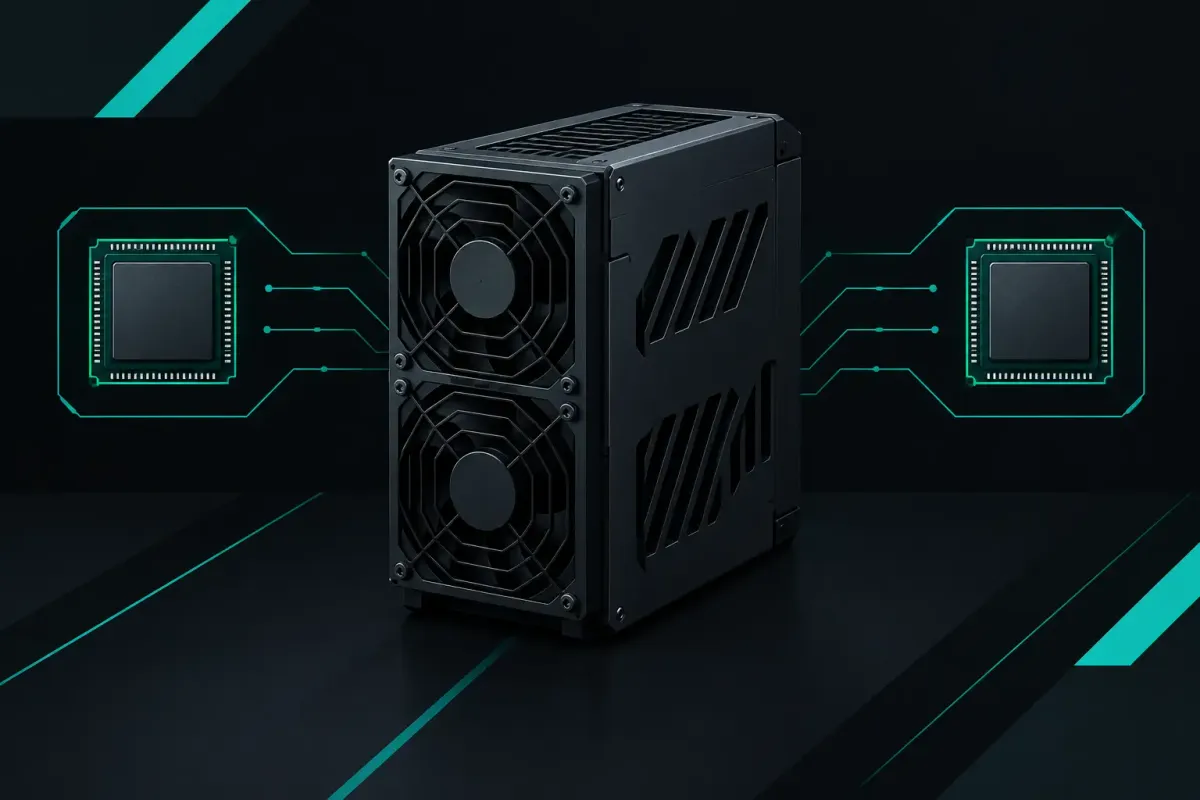
It is Sunday afternoon, August 24, and a hobbyist scrolling a Nostr feed stops on a post from the Solo Satoshi project: a photo of a new board, a short spec list, and a single word that gets attention in this corner of the internet, duo. Two BM1373 3nm ASICs on one open-source board, 4.4 TH/s at stock settings, over 8 TH/s overclocked, a 1.9 inch color display, and a note that the units are assembled entirely in the United States. The post links to a notify-me page and nothing else. No press release, no roadmap, just a hardware announcement dropped straight into the community that will actually build with it.
What Actually Changed in This Generation
The single-chip Bitaxe Gamma, the board most home miners already know, runs one BM1370-family ASIC at roughly 1.2 TH/s. The new Naja Duo puts two BM1373 chips on the same board instead of one, which is a real architectural step, not just a firmware tweak or a factory overclock. Two chips sharing a board means shared power delivery and shared thermal design have to work at a higher wattage than the single-chip boards were built for, and the fact that the stock hashrate lands at 4.4 TH/s rather than a simple doubling suggests some of that headroom went toward efficiency and stability rather than raw peak numbers.
This mirrors a pattern already visible elsewhere in the open-hardware scene. The NerdQAxe++, a four-chip board built on BM1370 silicon (the same chip family inside Bitmain's industrial Antminer S21 Pro), already proved that stacking multiple ASICs on one small, quiet, Wi-Fi-connected board is a viable path for a home setup: 4.8 TH/s at about 72 watts, roughly 15 J/TH efficiency, and a noise profile quiet enough to sit on a shelf. The Naja Duo is a different design choice on the same underlying idea, fewer chips, a newer node, aimed at a different point on the price-to-hashrate curve.
Efficiency is the number worth watching alongside raw hashrate. The original single-chip Bitaxe boards run in the 15 to 20 J/TH range depending on revision, and the NerdQAxe++ improves on that at roughly 15 J/TH across four chips. A dual-chip board built on a newer 3nm process landing in a similar or better J/TH band would mean the jump to 4.4 TH/s does not come with a proportional jump in the power bill, which matters more to a hobbyist running a board continuously than the headline hashrate number does on its own. The announcement itself did not publish a firm retail price or ship date, only a notify-me link, so anyone weighing whether to wait for this board over an already-available NerdQAxe++ or Bitaxe Gamma is currently making that call without full information, and that uncertainty is worth sitting with rather than assuming a specific number.
What Doubling or Tripling Your Hashrate Actually Buys You
None of this changes what actually decides whether a solo miner finds a block. That is set entirely by a miner's own hashrate divided by the network's total hashrate, identical for every device on the chain, and no board design changes that ratio's fundamentals, only its inputs. It is worth running the real numbers rather than a vague sense of "more is better."
A Bitaxe Gamma at 1.2 TH/s against a Bitcoin network hashrate of roughly 900,000,000 TH/s (900 EH/s) gives a per-block probability of about 1.2 divided by 900,000,000, or roughly 1 in 750 million. At Bitcoin's roughly 52,560 blocks per year, that works out to an expected wait of about 14,269 years running continuously. The new Naja Duo at 4.4 TH/s stock changes that same calculation to 4.4 divided by 900,000,000, about 1 in 204.5 million, which works out to an expected wait of roughly 3,892 years, close to a third of the Gamma's figure, tracking the roughly 3.7x hashrate increase almost exactly. Push the board to its overclocked 8 TH/s ceiling and the math moves again, to about 1 in 112.5 million and an expected wait near 2,140 years. Faster hardware means a genuinely shorter wait. It does not mean a likely one, and none of these numbers are a schedule.
What This Doesn't Claim
This post does not claim the Naja Duo or the NerdQAxe++ make solo mining a reasonable path to guaranteed income, or that either board changes anything about the underlying probability math beyond the hashrate figure itself. It does not claim new hardware is required to keep solo mining; the original single-chip boards still work exactly as they always have. It also isn't investment advice, and finding a block remains a probabilistic outcome, not a plan.
Back to the Feed
The hobbyist closes the Nostr post, taps the notify-me link, and keeps scrolling. Nothing about the setup running right now changes today. What changed is the shape of the next upgrade decision, a board that turns roughly three years of expected waiting into roughly one, still astronomically unlikely, still fully honest about it. That connection between whichever board ends up on the desk and the rest of the mining setup runs through the same protocol either way; NexusPool's connection layer speaks both Stratum V1 and Stratum V2 automatically, so an older single-chip board and a brand-new dual-ASIC one connect the same way, no reconfiguration required. And whichever board eventually finds a block, NexusPool's Payout Preflight tool checks that block's coinbase transaction byte for byte before the celebration starts, not after.
Trust nothing. Verify what a new hashrate number actually changes before you decide it matters to you.