Payout Preflight
Bitcoin's Mining Difficulty, By the Numbers, Sits Just 0.7% Above Its 2026 Low
Bitcoin's difficulty sits just 0.7% above its 2026 low as hashprice jumps 20%. Here is the full arithmetic on what that means, and does not mean, for solo odds.
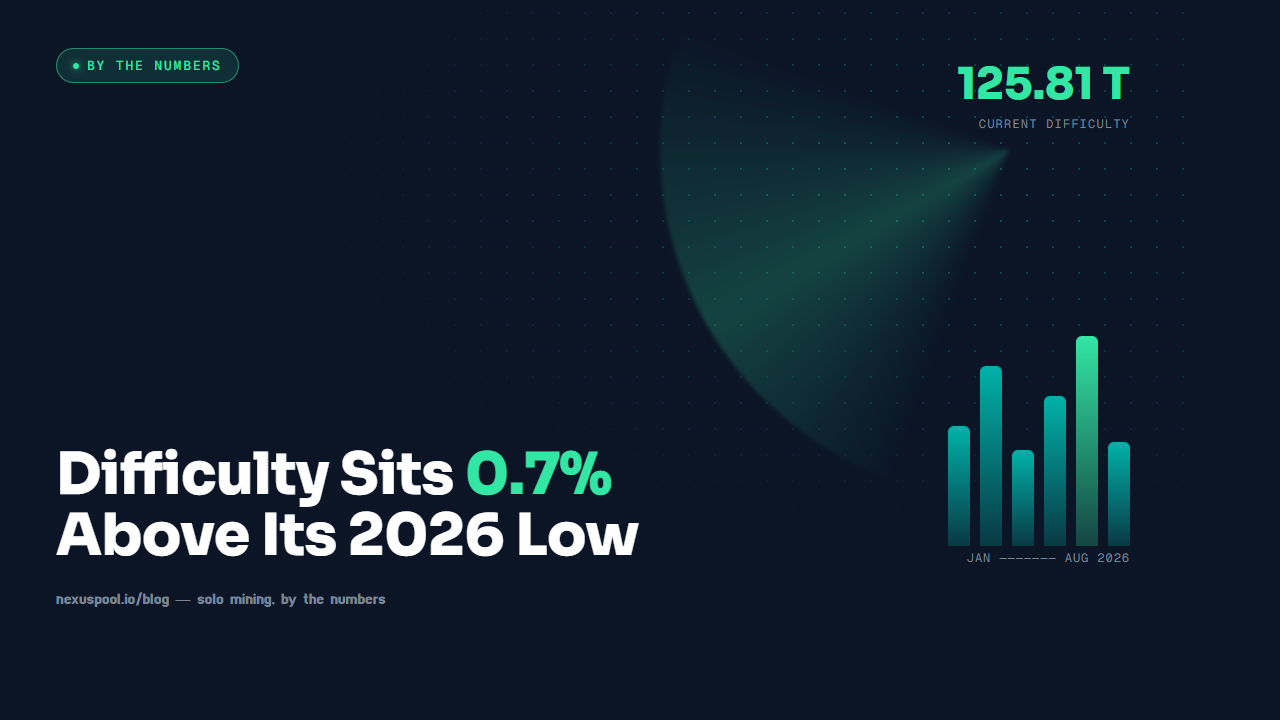
One number frames the entire year for Bitcoin miners in 2026: 125.81 trillion. That is the current mining difficulty as of the adjustment at block 963,648 on August 22, a 1.31% drop from the prior epoch. It sits just 0.7% above 124.93 trillion, the lowest difficulty recorded anywhere in 2026, logged back on June 13. Every other figure in this story, the count of adjustments, the hashrate that has left the network, the recent bump in miner revenue per hash, follows from that one number, so it is worth building outward from it rather than treating any single headline in isolation.
The Year So Far, in One Table
| Metric | Value |
|---|---|
| Current difficulty (block 963,648) | 125.81 T |
| 2026 low (June 13) | 124.93 T |
| Gap above the 2026 low | 0.7% |
| Difficulty at start of 2026 | 148.25 T |
| Drop from start of year to current | roughly 15.1% |
| Downward adjustments in 2026 | 10 |
| Upward adjustments in 2026 | 7 |
| Hashrate estimated to have left the network since the peak | roughly 150 EH/s |
| Recent hashprice move | up roughly 20% |
Difficulty has spent 2026 whipsawing rather than climbing steadily. It fell to that 124.93 T low in June, clawed back to 133.87 T, slipped to 127.17 T, dropped again to 126.23 T, bounced to 127.48 T in mid-August, and has now retreated to 125.81 T. Ten downward adjustments against seven upward ones is not a network in freefall, but it is a network that has spent more of the year losing hashing power than gaining it, and the recoveries have repeatedly failed to hold.
The mechanism behind each of these adjustments is fixed by Bitcoin's code and worth stating plainly: every 2,016 blocks, the network compares how long that batch of blocks actually took to mine against the 10-minute-per-block target, then retargets difficulty up or down to correct the gap. The latest adjustment at block 963,648 followed a batch of blocks mined slightly slower than target, the direct fingerprint of hashrate leaving the network mid-epoch, which is why a 1.31% difficulty drop and a hashrate estimate falling by a similar percentage are really two views of the same underlying event rather than two separate pieces of news.
What a Lower Difficulty Actually Changes for a Solo Miner
Difficulty and network hashrate move together by definition: the same math that produces a lower difficulty figure is the math that shows real mining capacity leaving the network. A week earlier, before this latest adjustment, the network was running at roughly 912.5 EH/s. The 1.31% drop tracks closely with that hashrate estimate easing to roughly 900 EH/s today. That matters directly for the only number that actually governs solo mining odds: a miner's own hashrate divided by the network's total hashrate.
Take a representative solo device running at 1.2 TH/s. Against last week's 912.5 EH/s (912,500,000 TH/s), the per-block probability was about 1.2 divided by 912,500,000, roughly 1 in 760.4 million, working out to an expected wait near 14,467 years at Bitcoin's roughly 52,560 blocks per year. Against today's lower estimate of 900 EH/s (900,000,000 TH/s), the same device's odds improve slightly to about 1 in 750 million, an expected wait near 14,269 years. That is a real, computable difference of roughly 198 years, about 1.4% shorter, moving in the miner's favor purely because other hashing power left the network. Nothing about a miner's own hardware or pool changed; the denominator in the equation simply got smaller.
What the Hashprice Jump Adds to the Picture
Hashprice, the revenue a fixed amount of hashrate earns per day, has climbed roughly 20% in the days since the latest difficulty drop, giving miners still running some real breathing room after a year that has generally squeezed margins. That recovery sits against a broader backdrop: Bitcoin's price gap from its October 2025 all-time high above $126,000 has narrowed from more than 50% to about 38.8%. A rising hashprice makes it marginally more sustainable to keep hardware running, which is precisely why hashrate leaving the network and difficulty easing are connected rather than coincidental: less profitable mining capacity gets switched off, difficulty adjusts down to match, and the miners who stay see both a slightly better hashprice and, as shown above, marginally better solo odds.
What This Doesn't Claim
This post does not claim difficulty near a yearly low means a solo block is likely, or that a hashprice recovery is a signal to increase hashrate for profit. The odds above remain astronomically long regardless of a 1.4% swing either direction, and none of this is investment advice. It also does not claim NexusPool's own core source code is public; NexusPool is free with no fee, but the code itself is not yet open for outside review.
Do not chase this week's hashprice number as a reason to expect a payout on any particular timeline. What the arithmetic above actually supports is narrower and more honest: for anyone already solo mining, this is a moment where the numbers moved slightly in your favor, not a moment where they moved toward likely. If you want to see exactly how a found block's payout gets verified rather than assumed, a tool that checks the coinbase transaction before a block is even found does that work byte for byte, on Bitcoin and on the merged-mined chains alike.
Trust nothing. Verify today's actual difficulty and hashrate before assuming last week's numbers still apply.