Bitcoin Mining
If Miners Are Leaving for AI, Why Is Hashrate High?
Public Bitcoin miners are cutting hashrate for AI contracts, yet the network sits near a record. Here is what that does, and does not, change.
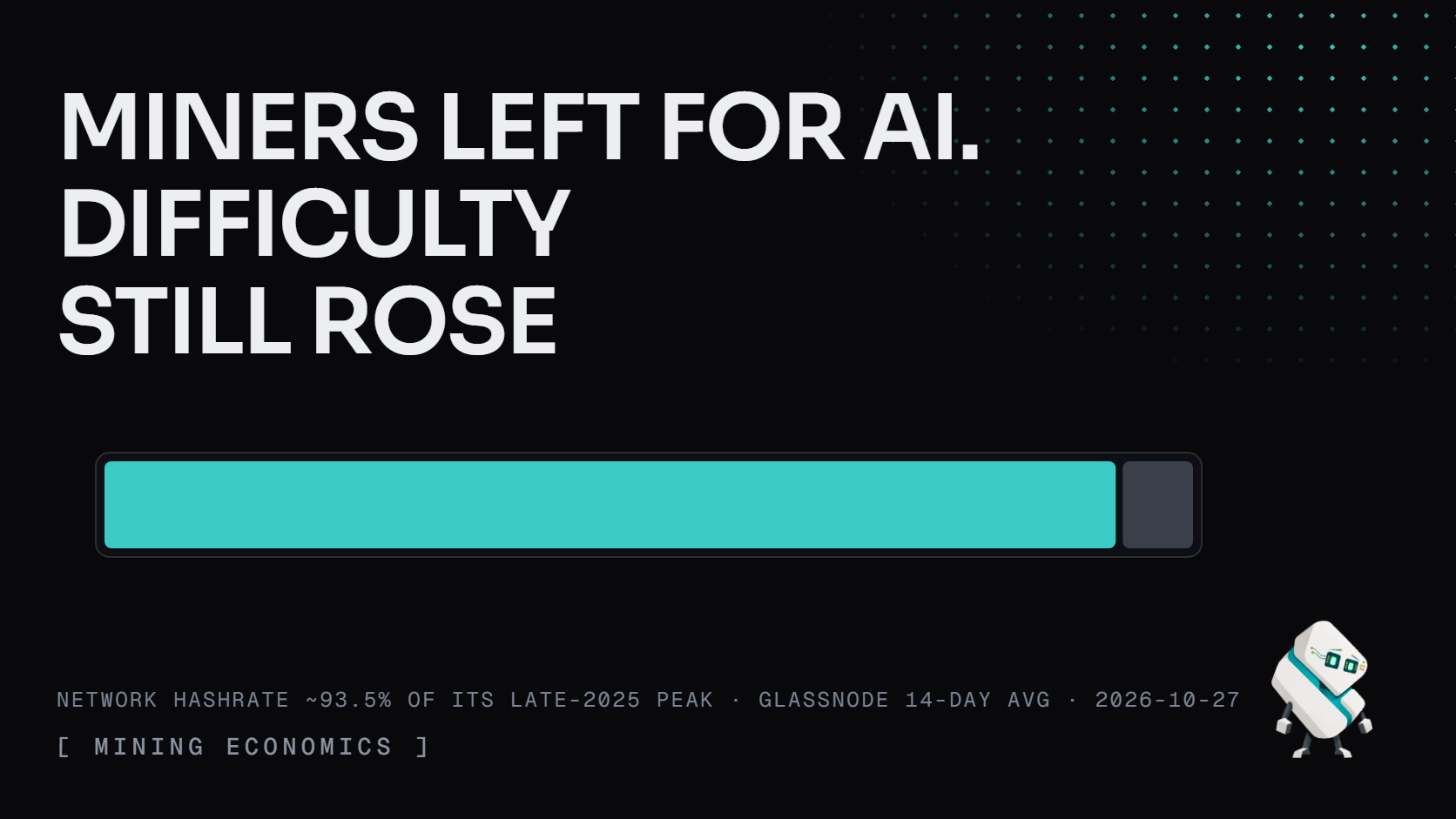
Bitcoin's biggest public mining companies spent 2026 doing something that sounds like it should matter a lot to anyone running a solo rig: they started pointing power and capital at AI data centers instead of Bitcoin. Reporting this week put the shift in concrete terms. According to BeInCrypto on October 28, 2026, citing BlocksBridge Consulting, public miners' realized hashrate fell 15% in the first half of 2026, and disclosed AI and high-performance computing contracts across listed miners now exceed $70 billion. IREN plans to retire about 23.2 EH/s of mining capacity by December 31. Riot Platforms disclosed a 20-year, 191-megawatt hosting deal at its Rockdale, Texas campus in August, worth $9.1 billion or up to $16.1 billion with extensions.
That is a real business story. It is also, on its face, the kind of headline that gets forwarded in mining forums with a hopeful question attached: if the big players are leaving, does the rest of us get a better shot? Here are the questions worth asking before anyone answers that with a yes.
Are Bitcoin miners actually leaving for AI, or is this overstated?
The listed ones are, at least in part. These are public companies with earnings calls and filings, so the direction of the trend is not really in dispute: hashrate retirements on one side, multi-year hosting contracts on the other. The size of the move is less dramatic than the contract headlines suggest. CoinShares estimates, in the same reporting, that only about $1.1 billion of that $70 billion AI backlog is billed annually so far. And listed miners are only part of the network. How much of total hashrate the pivot actually removes depends on everyone else, which is the next question.
If big miners are leaving, why hasn't the network's hashrate collapsed?
Because something else filled the gap. The same reporting credits one listed miner that kept expanding its own fleet, smaller operators buying the rigs public miners retired, Texas fleets returning after the summer grid peak, and growth in newer regions such as Ethiopia, Paraguay and Oman. The result is a network that looks almost unchanged from the outside even though its ownership shifted underneath. By Glassnode's 14-day moving average, cited by BeInCrypto, hashrate sits near 1.06 ZH/s, roughly 6.5% below its late-2025 peak of about 1.135 ZH/s. That squares with the arithmetic (1.06 divided by 1.135 is about 0.934). Other trackers read the same week a little differently; one weekly market report put it at 1,064 EH/s. Different methods and different averaging windows give slightly different numbers, but all of them describe a network close to its high, not one that is thinning out. Anyone who wants today's exact figure should check a live source like mempool.space rather than treat any single snapshot as final.
Does a smaller share of big public miners mean better odds for a home rig?
No, and this is the question that actually matters for anyone mining solo. A rig's odds of finding a block are set by its own hashrate divided by network difficulty, and that difficulty is the same number for every participant, at every pool, NexusPool included. Difficulty does not care who owns the hashrate behind it, only how much exists in total. And difficulty did not fall during this AI pivot. It rose 5.92% on October 16, 2026, to about 140.58T, and trackers project another increase of roughly 5% to 6% at the next retarget around October 29. If that holds, difficulty lands near 148T to 150T, within about 5% of its late-2025 record of 155.97T. If public miners leaving for AI were actually shrinking the network, difficulty is where it would show up first, as a cut rather than back-to-back increases. It has not shown up there. A story about corporate capital allocation is not the same as a story about your own expected wait for a block, and conflating the two is exactly the kind of hopeful math that solo mining punishes.
So what would actually have to happen for solo-mining odds to improve?
Total network hashrate would need to fall faster than new hashrate replaces it, and that net drop would need to show up in a lower difficulty at an adjustment. Nothing in this week's reporting suggests that is happening. It could change: IREN's planned retirement in December removes real capacity, and hashprice fell to about $36 per petahash per day on October 25, down roughly 11% in a month per Hashrate Index data, which squeezes the operators with the most expensive power. But a squeeze on margins is a forecast, not a difficulty cut, and the network has absorbed every exit so far. None of this is a prediction that difficulty will keep climbing forever, and nobody mining solo should treat any of it as a signal to expect a find sooner. Solo mining is a lottery. An average interval between wins is not a schedule, and a lower difficulty, if it ever arrives, means a shorter expected wait, not a guaranteed one and not more value per find.
Where does NexusPool fit into a story about difficulty and corporate hashrate?
It does not change the odds, because nothing but hashrate and difficulty does. What a pool controls is the path between a share your rig submits and whatever happens next, and that part is worth being able to check regardless of which way the AI story goes. NexusPool signs an hourly Glass Ledger receipt for every rig it serves, naming the shares and the difficulty counted, built against a published key so a reader checks it rather than takes a pool's word for it; more on how that works sits on NexusPool's technology page. Because the pool is non-custodial, with a 0% fee and the full block reward paid straight to the finder's own address, there is also no balance sitting anywhere for a pool to mismanage if a public miner's AI pivot, or anything else, reshuffles the industry again. A miner can see exactly what a find would pay, before it happens, with NexusPool's Payout Preflight tool, built from the same code that constructs a real block. None of this is investment advice, and nothing here promises a find or better odds than difficulty already sets for every rig pointed at the network, whichever pool it uses.
The honest answer to the question in this post's title: hashrate is close to a record because private operators, retired rigs changing hands and new regions filled the gap public miners left, and the number that actually decides your odds, network difficulty, has been climbing, not falling.
Trust nothing. Verify where the hashrate actually went this week.