Bitcoin Mining News
El Reno's Bitcoin Mine Leak: The Questions Worth Asking
A Bitcoin mining site in El Reno, Oklahoma leaked 3.8 million gallons and closed schools. What caused it, why it kept running, what it means for home miners.
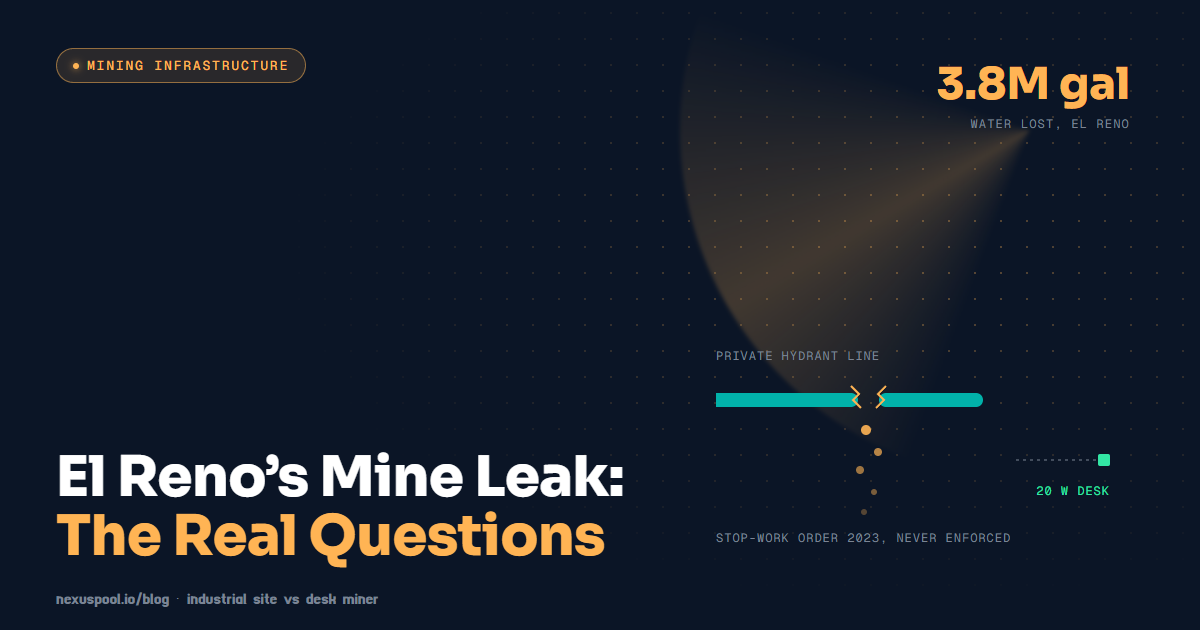
On Monday, September 14, attorneys for the company behind a Bitcoin mining site in El Reno, Oklahoma sat down with city legal staff to go through a long list of code violations, then walked to the parking lot without answering a reporter's questions. The site, owned by Athlon BT, was the source of a Bitcoin mining water leak in late August that city officials put at 3.8 million gallons. Water pressure dropped far enough that the city shut off service to part of town and El Reno Public Schools canceled classes for two days. The city has condemned the property and admits it never enforced a stop-work order it issued in 2023. Most coverage stops at the headline, so here are the questions a miner should ask.
What Caused the Bitcoin Mining Water Leak?
City officials traced the loss to a fire hydrant on a private water line at the site, in the 800 block of West Jensen Road. Early estimates put the loss at about 3 million gallons; the city later updated the figure to 3.8 million. To bring pressure back, the city temporarily cut water to customers south of Interstate 40 and west of Highway 81, and schools closed on a Wednesday and Thursday. Nothing in the city's statements ties the leak to how the facility cooled its machines. It was a failed private water line on a property the city says should not have been operating.
Why Did the Site Keep Running After a 2023 Stop-Work Order?
The city issued Athlon BT a building permit in 2021. In June 2023, inspectors found fire and life-safety violations along with expired building and electrical permits and issued a stop-work order. The owner had until December 2023 to get new permits, and operations were supposed to stay suspended until the site earned a certificate of occupancy. It never got one. The facility kept building and operating anyway.
City Manager Ken Brown has said the city failed by not following through, and officials blamed lack of communication and staff turnover. That leaves two failures stacked together: an operator that ignored an order, and a city that forgot it had issued one.
What Happened at the September 14 Hearing?
According to KFOR's report on the hearing, Athlon's attorneys discussed the violations the company had already been notified of, including making sure a trailer on the property does not have power running to it illegally. They promised to keep working on corrections and are due back in 30 days for another check-in. The city is still working out what to charge the company for the lost water, the staff hours spent finding the leak and the canceled school days. Athlon has not returned calls from local reporters.
Was This a Bitcoin Problem or an Operator Problem?
The facts point at one operator and one permit file. The Bitcoin network has no say over whether a building has a certificate of occupancy or whether a hydrant line gets inspected. The same proof-of-work rules apply to a warehouse of ASICs in Oklahoma and to a single board on your desk. What differs is everything physical around the machines: the power contracts, the water lines, the fire code and the paperwork a city expects before a building opens.
Mining still gets the headline, and that has consequences. When one large facility ignores a city for three years and then drains its water supply, every other operator in the region can expect harder questions at the next permit hearing, whether or not they earned them.
Does a Home Mining Setup Carry Anything Like This Risk?
Not at this scale. An open-hardware miner like a Bitaxe draws roughly 15 to 20 watts, less than an old incandescent bulb, runs on a desktop power supply and needs no plumbing at all. It has no hydrant line to fail, no occupancy certificate to skip and no stop-work order to ignore. Your home setup does come with its own checklist: a proper outlet, airflow and whatever your lease or local rules say about running equipment around the clock. Nothing on that list resembles what El Reno is dealing with.
Scale changes exposure, not odds. Your chance of finding a block equals your hashrate divided by the network's hashrate, the same formula at every pool and every facility size. A home miner is not a substitute for industrial hashrate, and no pool, NexusPool included, improves those odds.
What Can You Check About Your Own Mining?
The El Reno story is about trust that nobody verified: a city trusted a paper order to hold, and residents trusted the city. You can avoid that pattern in the part of mining you control. NexusPool is a non-custodial solo pool, and its Payout Preflight tool rebuilds the coinbase transaction the pool would pay to your address against the live block template, so you check the output before a block arrives. The status page shows current pool health instead of asking you to assume uptime, the technology page documents the Stratum V1 and Stratum V2 path your hashrate takes, and the about page says who runs the pool. NexusPool's core software is not open source, and none of this is legal or investment advice.
So, does El Reno say anything about the desk miner? Only this: the risks in that story came from a building, a water line and an unenforced order, and a 20-watt board on your desk has none of the three.
Trust nothing. Verify what your own setup connects to before you trust a headline about mining in general.