Stratum V2
Stratum Adoption Trends Miners Can Verify
Stratum adoption trends show why miners are moving toward encrypted, accountable connections while Stratum V1 remains useful for existing hardware today.
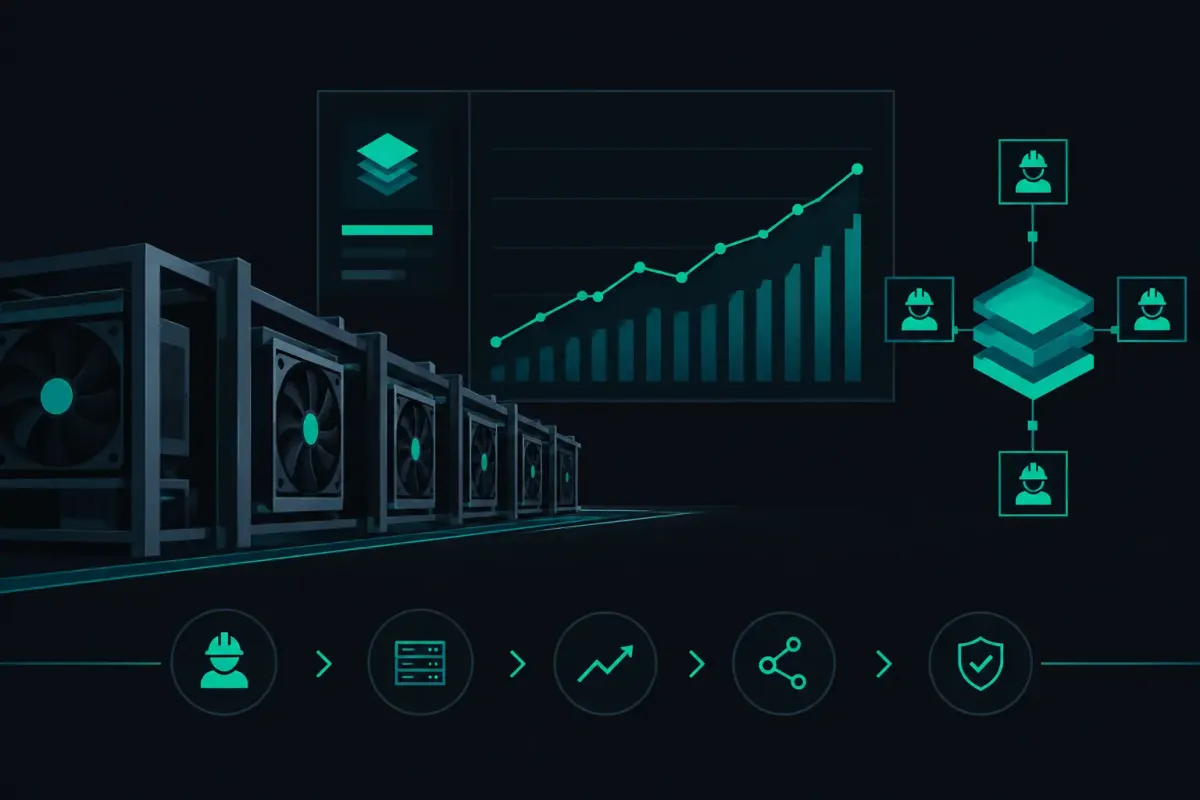
A miner can point a machine at a pool in under a minute. Knowing what happens after the connection opens is harder. That is why stratum adoption trends matter. They are not just about which protocol has newer features. They show whether miners can keep using familiar hardware while gaining clearer control over who assigns work, who can observe it, and where a solved block pays.
For home miners and small fleets, the practical question is simple: does a protocol change reduce a trust assumption you can name? If it does, adoption is worth watching. If it only adds a logo to a dashboard, it is not.
Stratum adoption trends are uneven by design
Stratum V1 remains the working language of a large share of Bitcoin mining hardware. Standard ASICs speak it. Older firmware speaks it. The setup path is familiar: enter a pool address, port, worker name, and password, then begin submitting shares. Its longevity is not evidence that miners do not care about better security. It reflects the installed base.
A home operator with a Bitaxe Gamma, NerdQAxe++, or a conventional ASIC generally wants the machine to work without putting a protocol conversion box between the miner and the pool. Replacing functioning equipment solely to change transport protocols is not a rational requirement. Hardware life cycles are long. Firmware support is fragmented. Adoption follows that reality.
Stratum V2 addresses limitations that V1 did not set out to solve. Native V2 uses encrypted transport through the Noise protocol. It supports authority-key pinning, so a miner can identify the authority it intended to connect to instead of accepting an unverified replacement. Its message structure is also designed for clearer roles and more efficient operation.
But protocol adoption is not a switch that flips across the network. It happens at the intersection of miner firmware, pool support, proxy availability, documentation, and operator appetite for configuration risk. A feature is only useful when the person running the hardware can confirm it is active.
Why encrypted mining connections are becoming relevant
A plain Stratum V1 connection exposes more than many miners assume. Depending on the network path, an observer can see pool endpoints, worker identifiers, and job traffic. The connection can also be more vulnerable to manipulation than an authenticated encrypted session. That does not mean every V1 miner is under attack. It means the protocol does not provide the same protection when something on the path is hostile or misconfigured.
For a single home miner, this may sound theoretical. It becomes less theoretical when a miner relies on public Wi-Fi, outsourced network equipment, a shared building connection, or DNS settings they did not choose. Small fleets have the same problem at a larger scale. The point is not to manufacture fear. The point is to stop treating unencrypted work assignment as invisible plumbing.
V2's authority-key pinning matters for the same reason. TLS has trained people to look for a lock icon, then move on. Mining needs a more specific question: which key is authorized to assign this work? A miner that pins the expected authority key can reject a connection that presents the wrong identity, even if the network route looks normal.
Encryption does not prove that a pool pays honestly. It does not improve a miner's chance of finding a block. Nobody changes your luck. Us included. It protects the path used to receive and submit work. That is a narrower claim, and it is the one the protocol can support.
V1 still has a place
The case for V2 should not become an excuse to dismiss V1 miners. A protocol that existing hardware can use is valuable infrastructure. V1 will remain relevant as long as miners own devices that only speak V1, and that could be a long time.
The better direction is parallel support. Let V1 hardware connect without pretending it has V2 security. Let native V2 firmware use encryption and key pinning without a translator. Give operators a way to select the connection they understand and verify the behavior at the endpoint.
That approach matters especially for ESP32-class miners. Bitaxe AxeOS and BraiinsOS+ are among the smaller set of firmware options with native V2 support. Most other miners that want to reach a V2-only service need a translator in the middle. A shared endpoint that accepts both protocols removes that extra component for the people who need V1 today, while leaving a native encrypted path available for miners that support it.
The next adoption signal is not a percentage
It is tempting to measure adoption with one number: how many miners use V2? That number can be useful, but it can also hide the more meaningful changes. A pool can advertise V2 while offering no clear way to validate its identity key. A miner can run a proxy and report a V2 connection while still depending on another device that needs maintenance and trust.
Better adoption signals are operational. Can a miner see which protocol was negotiated? Can they obtain the expected authority public key through a documented channel? Does a failed key check fail closed instead of quietly falling back to an unprotected session? Can they distinguish a V1 connection from an encrypted V2 connection in logs?
These are not cosmetic details. They determine whether an operator can detect that the promised security property is absent.
The same standard applies to pool accounting. Stratum carries shares, which are proofs of attempted work at an assigned difficulty. Shares are not Bitcoin payments. They do not prove that a pool has custody practices you want, that its fee calculation is correct, or that a future block payout will reach your address. Protocol security and payout verification solve different problems.
A serious mining setup keeps those claims separate. Verify the transport. Verify accepted-share behavior where the pool makes it observable. Verify the block payout on-chain if a block is solved. Do not merge them into a vague feeling that the connection is trustworthy.
Job selection will test what miners actually want
One of the most discussed parts of Stratum V2 is job negotiation. In designs that support it, miners may gain more say over transaction selection rather than merely hashing a template supplied by a pool. This has obvious appeal for censorship resistance and miner autonomy.
It also has trade-offs. Template construction needs a well-synchronized Bitcoin node and careful software. A home miner may not want to run additional infrastructure just to choose transactions. Pools and firmware need compatible implementations. Mining operations may prefer the operational simplicity of centrally constructed templates even when they support encrypted transport.
So job negotiation should not be used as a loyalty test. Its adoption will likely be slower and more conditional than encrypted transport. That is normal. The useful question is whether an operator can choose it when the hardware, node setup, and risk tolerance make sense.
For miners who do operate their own node, the direction is clear. The closer a miner gets to independently validating chain state and controlling work selection, the fewer opaque assumptions remain. That does not eliminate variance, network rules, or the economics of hashrate. It removes assumptions that were never necessary in the first place.
What to check before changing endpoints
Changing Stratum settings should be a controlled test, not a leap of faith. Start by recording the current hashrate, rejected-share rate, stale-share rate, and latency. Then change one variable. A new protocol is not automatically better if the endpoint is farther away or the miner firmware is unstable.
For native V2, confirm that the firmware reports an encrypted session and that its pinned authority key matches the pool's published key. Do not skip the second half. Encryption to an unknown endpoint is not the same as authenticated encryption to the endpoint you intended.
For V1, use the connection as honestly as it is. Check that the address and port are correct, use a payout address you control, and monitor share acceptance over enough time to avoid drawing conclusions from a few minutes of variance. If a service publishes independently checkable accounting records or signed operational data, verify the signature rather than treating the display as proof.
NexusPool follows this practical split by accepting Stratum V1 and native encrypted Stratum V2 on its Bitcoin connection path. Its model is direct on-chain payment to the miner's own address if the miner solves a block. That does not alter the lottery odds. It makes the payout destination a fact visible on the Bitcoin chain rather than an internal pool balance.
Adoption should leave miners with fewer blind spots
The lasting value of Stratum V2 is not that every miner must migrate immediately. It is that mining infrastructure can make fewer demands for blind trust. V1 compatibility recognizes the hardware people actually own. Native V2 gives supported miners a way to protect and authenticate their work connection. Independent node operation and direct on-chain payment address separate layers of the same problem.
Watch the details, not the announcements. Ask whether the key can be checked, whether encryption is active, whether a fallback is visible, and whether rewards can be traced to an address you control. The protocol is useful when it turns those questions into evidence.
Trust nothing. Verify the connection.